Treasury 2.0: Built For a New Era
by JPMorgan
T r easur y 2 . 0: Built f or a ne w er a

2 Treasury 2.0: Built for a N ew EraTable of contents Foreword 3 Compounding Convergence: Why Sequential Playbooks Are Obsolete 4
- Treasury Transformation S-Curve. . . . . . . . . . . . . . . . . . . . . . . . . . . . . . . . . . . . . . . . . . . . . . . . . . . . . . . . . . . . . . . . . . . . . . . . . . . . . . . . . . . . 5 Infrastructure: Legacy Architecture Nullifying ROI 7 2A. The AI Adoption Paradox . . . . . . . . . . . . . . . . . . . . . . . . . . . . . . . . . . . . . . . . . . . . . . . . . . . . . . . . . . . . . . . . . . . . . . . . . . . . . . . . . . . . . . . . . 8 2B. Agent-Native Infrastructure Becomes Table Stakes . . . . . . . . . . . . . . . . . . . . . . . . . . . . . . . . . . . . . . . . . . . . . . . . . . . . . . . . . . . . . . . . . . . . 10 2C. The Multi-Rail Payments Reality: No Single Rail Rules . . . . . . . . . . . . . . . . . . . . . . . . . . . . . . . . . . . . . . . . . . . . . . . . . . . . . . . . . . . . . . . . . . 16 2D. Digital Currency and Tokenization: Past the Hype Cycle, Not Yet Past the Litmus Test. . . . . . . . . . . . . . . . . . . . . . . . . . . . . . . . . . . . . . . . 19 Intelligence: The Next Frontier 22 3A. The Polycrisis Is the New Normal — And Treasury Must Treat It as Such . . . . . . . . . . . . . . . . . . . . . . . . . . . . . . . . . . . . . . . . . . . . . . . . . . . 23 3B. Regulatory Intelligence: From Reactive Compliance to Strategic Foresight . . . . . . . . . . . . . . . . . . . . . . . . . . . . . . . . . . . . . . . . . . . . . . . . 25 3C. Payment Fraud: The Flywheel That’s Growing Faster Than Defense. . . . . . . . . . . . . . . . . . . . . . . . . . . . . . . . . . . . . . . . . . . . . . . . . . . . . . . 26 Talent: Pillar on Which Every Other Transformation Rests 294A. AI Is Advancing Fast — But Not Fast Enough to Replace Judgment . . . . . . . . . . . . . . . . . . . . . . . . . . . . . . . . . . . . . . . . . . . . . . . . . . . . . . . 30 4B. The Talent Squeeze Is Already Here — And It’s Getting Worse . . . . . . . . . . . . . . . . . . . . . . . . . . . . . . . . . . . . . . . . . . . . . . . . . . . . . . . . . . . 31 4C. The New Skill Stack: Domain Expertise Is Necessary But No Longer Sufficient. . . . . . . . . . . . . . . . . . . . . . . . . . . . . . . . . . . . . . . . . . . . . . 33 Strategy: The Path Forward 35 5A. In-House Bank Journey Becomes a Strategic Imperative . . . . . . . . . . . . . . . . . . . . . . . . . . . . . . . . . . . . . . . . . . . . . . . . . . . . . . . . . . . . . . . 37 5B. Working Capital: The $761 Billion Opportunity Hiding in Plain Sight. . . . . . . . . . . . . . . . . . . . . . . . . . . . . . . . . . . . . . . . . . . . . . . . . . . . . . . 38 5C. Beyond Working Capital: Treasury’s Seat at the Deal Table . . . . . . . . . . . . . . . . . . . . . . . . . . . . . . . . . . . . . . . . . . . . . . . . . . . . . . . . . . . . . . 41 Conclusion 43 Further Reading 45 Sources . . . . . . . . . . . . . . . . . . . . . . . . . . . . . . . . . . . . . . . . . . . . . . . . . . . . . . . . . . . . . . . . . . . . . . . . . . . . . . . . . . . . . . . . . . . . . . . . . . . . . . . . . 47
3
Treasury 2.0: Built for a N ew EraFor decades, corporat e treasury has earned its reputation by protecting v alue - safeguarding cash,
managing exposures, ensuring compliance. That mandate hasn’t changed.
But
the world around treasury is reconfiguring itself. Payments now move in seconds, markets shift in
minutes, boards exp ect answers in hours, and artificial intelligence is no longer a future promise - it is
a
present-day reality. This is fundamentally redefining how decisions are made, risk is managed, and
businesses operate.
Treasury must evolve accordingl y. Next-generation treasury isn’t just about doing the same things
faster; it’s about seeing soone r, deciding smarte r, and acting in r eal time.
This r
eport is our effort to map the journey from where most companies are today to where they must
be tomorr
ow - with clear trends, practical frameworks, and real-world blueprints to help companies
navigate complexity, embrace transformation, and build the next-generation corporate treasur y .Foreword
Patricia
Devine
Global Head of
Corporate SalesVaroon
Mandhana
Global Head of
Treasury AdvisoryTristan
Attenborough
Global Head
of AdvisoryNirav
Kakariya
N.A. Lead
Treasury Advisory
Compounding Convergence:
Why Sequential Playbooks
Are Obsolete
01

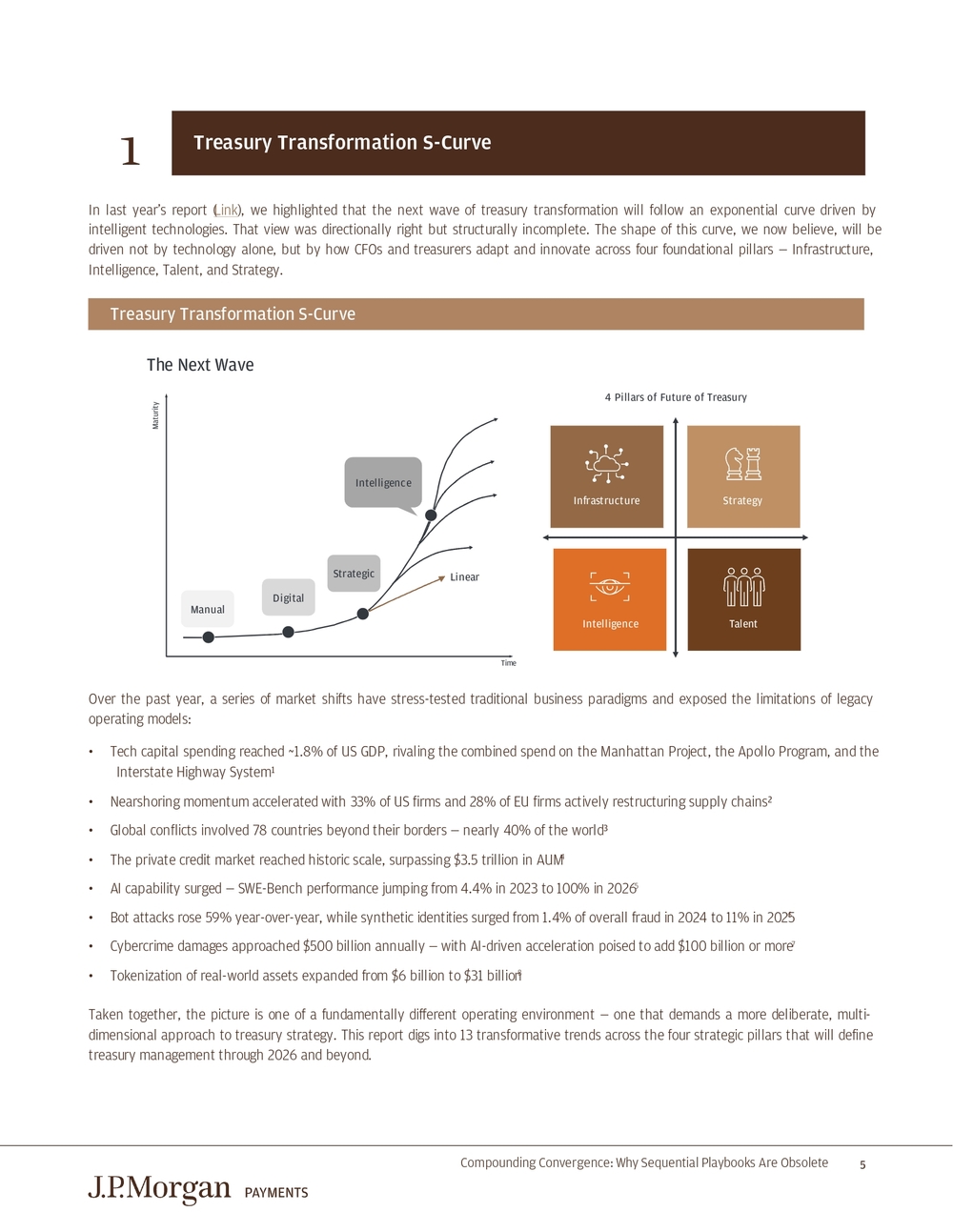
5 Compounding Convergence: Why Sequential Playbooks Are Obsolete The Next Wave 4 Pillars of Future of Treasury Strategy Infrastructure Intelligence Talent Maturity Linear Manual Digital Strategic Intelligence TimeIn last year’s report ( Link), we highlighted that the next wave of treasury transformation will follow an exponential curve driven by intelligent technologies. That view was directionally right but structurally incomplete. The shape of this curve, we now believe, will be driven not by technology alone, but by how CFOs and treasurers adapt and innovate across four foundational pillars — Infrastructure, Intelligence, Talent, and Strategy. Over the past year, a series of market shifts have stress-tested traditional business paradigms and exposed the limitations of legacy operating models: Taken together, the picture is one of a fundamentally different operating environment — one that demands a more deliberate, multi- dimensional approach to treasury strategy. This report digs into 13 transformative trends across the four strategic pillars that will define treasury management through 2026 and beyond.•Tech capital spending reached ~1.8% of US GDP, rivaling the combined spend on the Manhattan Project, the Apollo Program, and the Interstate Highway System¹ •Nearshoring momentum accelerated with 33% of US firms and 28% of EU firms actively restructuring supply chains² •Global conflicts involved 78 countries beyond their borders — nearly 40% of the world³ •The private credit market reached historic scale, surpassing $3.5 trillion in AUM4 •AI capability surged — SWE-Bench performance jumping from 4.4% in 2023 to 100% in 20265 •Bot attacks rose 59% year-over-year, while synthetic identities surged from 1.4% of overall fraud in 2024 to 11% in 20256 •Cybercrime damages approached $500 billion annually — with AI-driven acceleration poised to add $100 billion or more7 •Tokenization of real-world assets expanded from $6 billion to $31 billion8Treasury Transformation S-Curve1Treasury Transformation S-Curve
6
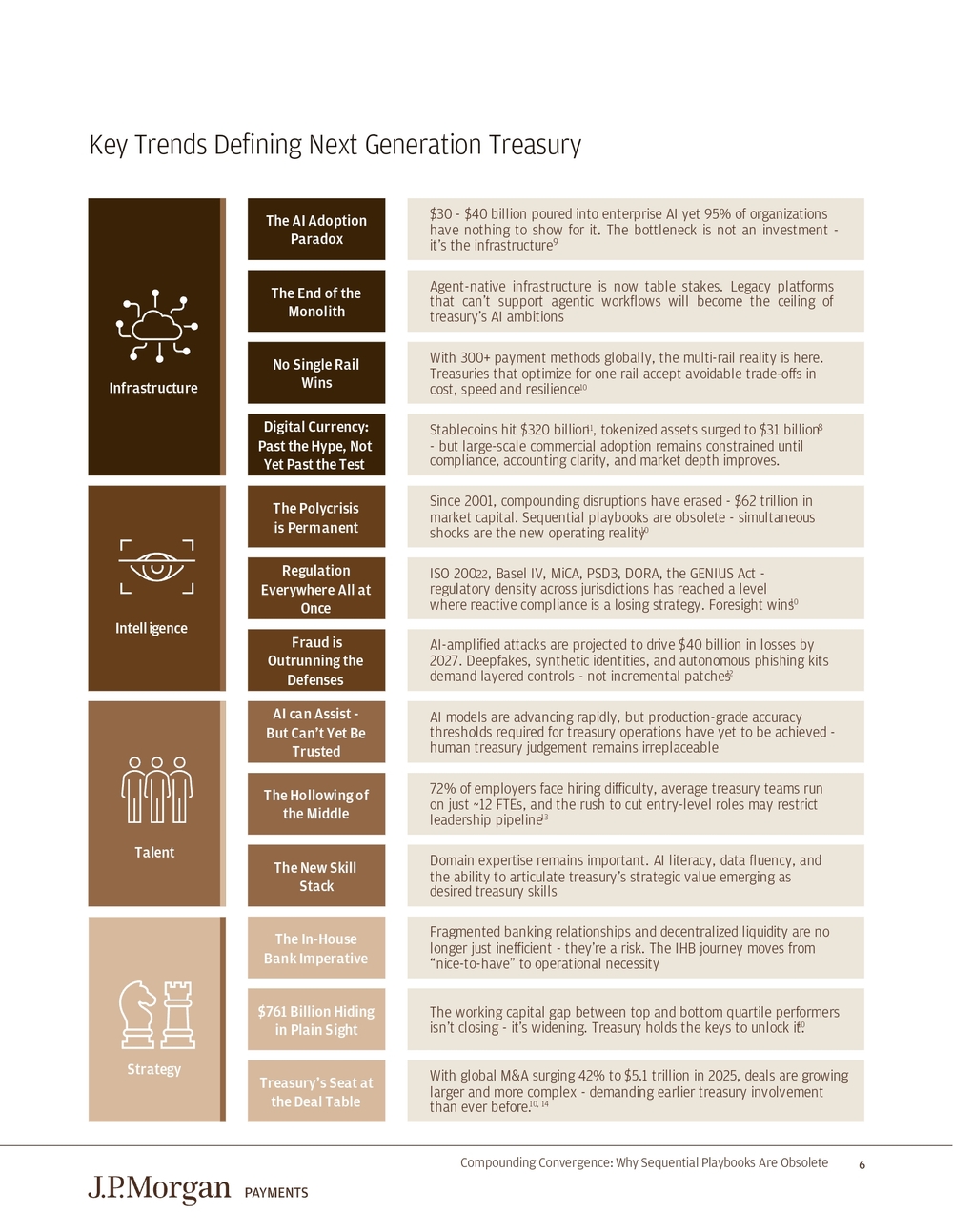
Compounding Convergence: Why Sequential Playbooks Are ObsoleteKey Trends Defining Next Generation Treasury
Infrastructure
Intelligence
Talent
Strat
egyThe AI Adoption
Paradox$30 - $40 billion poured into enterprise AI yet 95% of organizations
have nothing to show for it. The bottleneck is not an investment -
it’s the infrastructure9
Since 2001, compounding disruptions have erased - $62 trillion in
market capital. Sequential playbooks are obsolete - simultaneous shocks are the new operating reality
10With 300+ payment methods globally, the multi-rail reality is here.
Treasuries that optimize for one rail accept avoidable trade-offs in
cost, speed and resilie nce10
AI-amplified attacks are projected to drive $40 billion in losses by
2027. Deepfakes, synthetic identities, and autonomous phishing kits demand layered controls - not incremental patches
12The Polycrisis
is Permanent
AI can Assist -
But Can’t Yet Be
Trusted
The In-House
Bank ImperativeNo Single Rail
Wins
Fraud is
Outrunning the
Defenses
The New Skill
Stack
Treasury’s Seat at
the Deal TableThe End of the
MonolithAgent-native infrastructure is now table stakes. Legacy platforms
that can’t support agentic workflows will become the ceiling of
treasury’s AI ambitions
ISO 20022, Basel IV, MiCA, PSD3, DORA, the GENIUS Act -
regulatory density across jurisdictions has reached a level
where reactive compliance is a losing strategy. Foresight wins10Stablecoins hit $320 billion11, tokenized assets surged to $31 billion8
- but large-scale commercial adoption remains constrained until
compliance, accounting clarity, and market depth improves.
AI models are advancing rapidly, but production-grade accuracy
thresholds required for treasury operations have yet to be achieved -
human treasury judgement remains irreplaceable
Fragmented banking relationships and decentralized liquidity are no
longer just inefficient - they’re a risk. The IHB journey moves from “nice-to-have” to operational necessity72% of employers face hiring difficulty, average treasury teams run
on just ~12 FTEs, and the rush to cut entry-level roles may restrict
leadership pipeline13
The working capital gap between top and bottom quartile performers
isn’t closing - it’s widening. Treasury holds the keys to unlock it.10Domain expertise remains important. AI literacy, data fluency, and
the ability to articulate treasury’s strategic value emerging as
desired treasury skills
With global M&A surging 42% to $5.1 trillion in 2025, deals are growing
larger and more complex - demanding earlier treasury involvement than ever before.
10, 14Regulation
Everywhere All at
Once
The Hollowing of
the Middle
$761 Billion Hiding
in Plain SightDigital Currency:
Past the Hype, Not Yet Past the Test
Infrastructure: Legacy
Architecture Nullifying ROI02

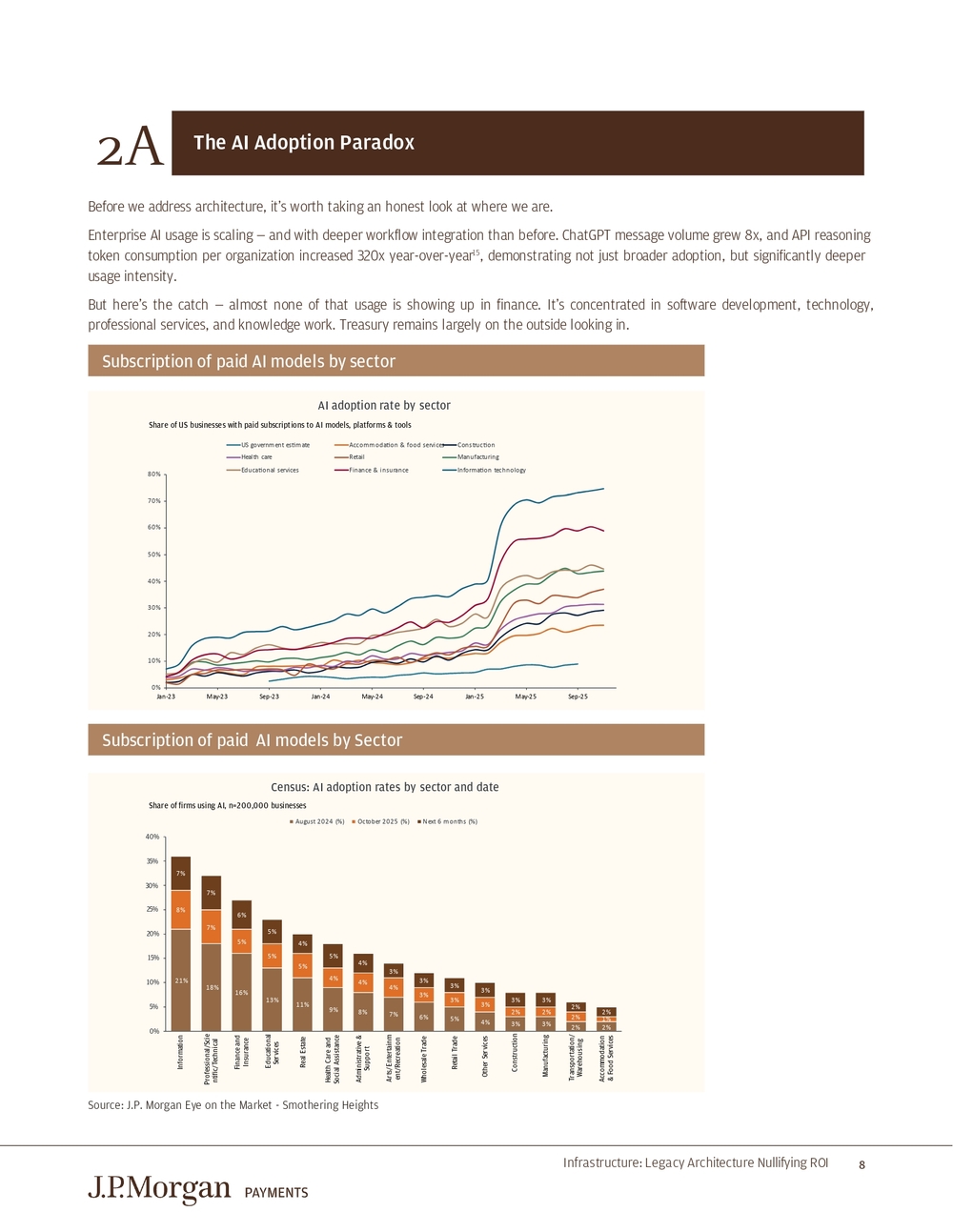
8 Infrastructure: Legacy Architecture Nullifying ROIBefore we address architecture, it’s worth taking an honest look at where we are. Enterprise AI usage is scaling — and with deeper workflow integration than before. ChatGPT message volume grew 8x, and API reasoning token consumption per organization increased 320x year-over-year15, demonstrating not just broader adoption, but significantly deeper usage intensity. But here’s the catch — almost none of that usage is showing up in finance. It’s concentrated in software development, technology, professional services, and knowledge work. Treasury remains largely on the outside looking in. Source: J.P. Morgan Eye on the Market - Smothering Heights2AThe AI Adoption Paradox Subscription of paid AI models by sector Census: AI adoption rates by sector and date Share of firms using AI, n=200,000 businesses 21% 18% 16% 13% 11% 9% 8% 7% 6% 5% 4% 3% 3% 2% 2% 8% 7% 5% 5% 5% 4% 4% 4% 3% 3% 3% 2% 2% 2% 1% 7% 7% 6% 5% 4% 5% 4% 3% 3% 3% 3% 3% 3% 2% 2% 0% 5% 10% 15% 20% 25% 30% 35% 40% Information Professional/Scie ntific/Technical Finance and Insurance Educational Services Real Estate Health Care and Social Assistance Administrative & Support Arts/Entertainm ent/Recreation Wholesale Trade Retail Trade Other Services Construction Manufacturing Transportation/ Warehousing Accommodation & Food Services August 2024 (%) October 2025 (%) Next 6 months (%) Subsc ription of paid AI mo dels by Sector Subscription of paid AI models by US businesses has been on the rise through 2025 AI adoption rate by sector Share of US businesses with paid subscriptions to AI models, platforms & tools 0% 10% 20% 30% 40% 50% 60% 70% 80% Jan-23 May-23 Sep-23 Jan-24 May-24 Sep-24 Jan-25 May-25 Sep-25 US government estimate Accommodation & food services Construction Health care Retail Manufacturing Educational services Finance & insurance Information technology
9
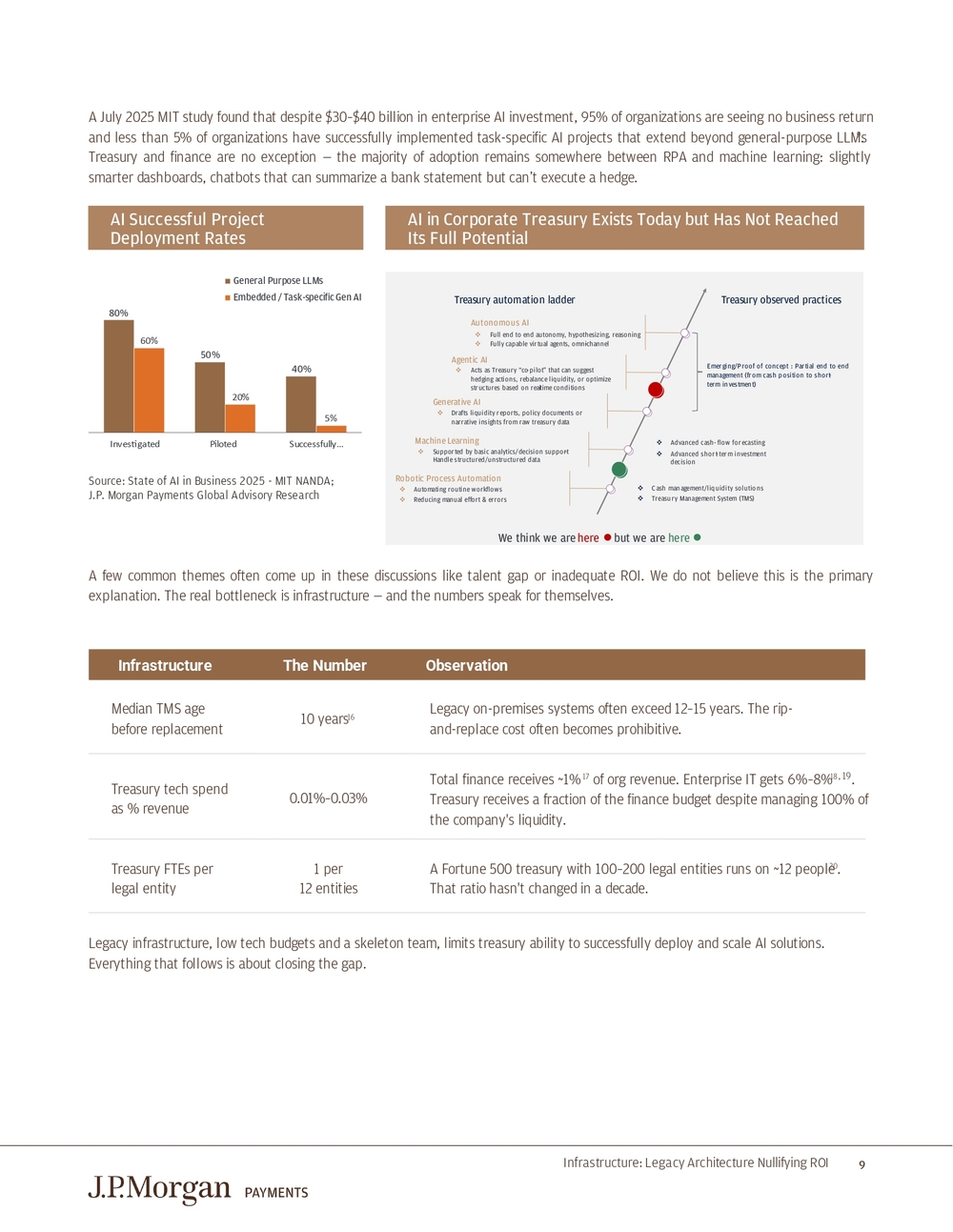
Infrastructure: Legacy Architecture Nullifying ROIA July 2025 MIT study found that despite $30–$40 billion in enterprise AI investment, 95% of organizations are seeing no business return
and less than 5% of organizations have successfully implemented task-specific AI projects that extend beyond general-purpose LLMs9.
Treasury and finance are no exception — the majority of adoption remains somewhere between RPA and machine learning: slightly smarter dashboards, chatbots that can summarize a bank statement but can’t execute a hedge.
A few common themes often come up in these discussions like talent gap or inadequate ROI. We do not believe this is the primary explanation. The real bottleneck is infrastructure — and the numbers speak for themselves.
Legacy infrastructure, low tech budgets and a skeleton team, limits treasury ability to successfully deploy and scale AI solutions.
Everything that follows is about closing the gap.Source: State of AI in Business 2025 - MIT NANDA;
J.P. Morgan Payments Global Advisory Research
Infrastructure The Number Observation
Median TMS age
before replacement10 years16Legacy on-premises systems often exceed 12–15 years. The rip-
and-replace cost often becomes prohibitive.
Treasury tech spend
as % revenue0.01%–0.03%Total finance receives ~1 % 17 of org revenue. Enterprise IT gets 6%–8%18, 19.
Treasury receives a fraction of the finance budget despite managi ng 100% of
the company's liquidity.
Treasury FTEs per
legal entity1 per
12 entitiesA Fortune 500 treasury with 100–200 legal entities runs on ~12 people20.
That ratio hasn't changed in a decade.
Robotic Process Automation
Automating routine workflows
Reducing manual effort & errors
Machine Learning
Supported by basic analytics/decision support
–
Handle structured/unstructured data
Generative AI
Drafts liquidity reports, policy documents or
narrative insights from raw treasury data
Agentic AI
Acts as Treasury “co
pilot” that can suggest hedging actions, rebalance liquidity, or optimize structures based on real
time conditions Autonomous AI Full end to end autonomy, hypothesizing, reasoning Fully capable virtual agents, omni
channel Cash management/liquidity solutions Treasury Management System (TMS) Advanced cash
flow forecasting Advanced short
term investment decision Treasury observed practices Treasury automation ladder We think we are here but we are here Emerging/Proof of concept : Partial end to end management (from cash position to short
term investment) AI in Corporate Treasury exists today but has not reached its full potential Generative AI project deployment rates 80% 50% 40% 60% 20% 5% Investigated Piloted Successfully… General Purpose LLMs Embedded / Task-specific Gen AIAI Successful Project Deployment RatesAI in Corporate Treasury Exists Today but Has Not Reached Its Full Potential
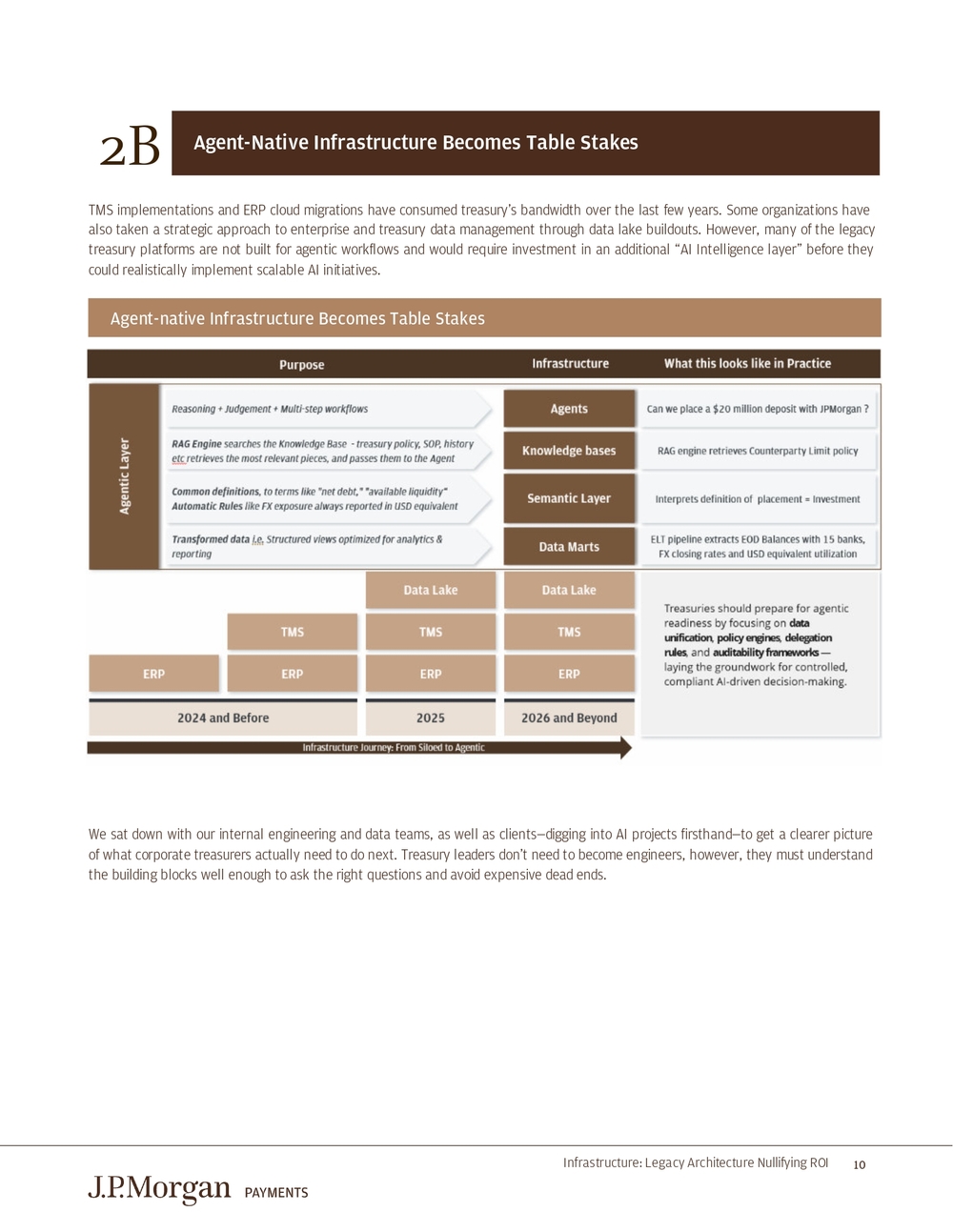
10 Infrastructure: Legacy Architecture Nullifying ROITMS implementations and ERP cloud migrations have consumed treasury’s bandwidth over the last few years. Some organizations have also taken a strategic approach to enterprise and treasury data management through data lake buildouts. However, many of the legacy treasury platforms are not built for agentic workflows and would require investment in an additional “AI Intelligence layer” before they could realistically implement scalable AI initiatives. We sat down with our internal engineering and data teams, as well as clients—digging into AI projects firsthand—to get a clearer picture of what corporate treasurers actually need to do next. Treasury leaders don’t need to become engineers, however, they must understand the building blocks well enough to ask the right questions and avoid expensive dead ends.Agent-native Infrastructure Becomes Table Stakes2BAgent-Native Infrastructure Becomes Table Stakes
11
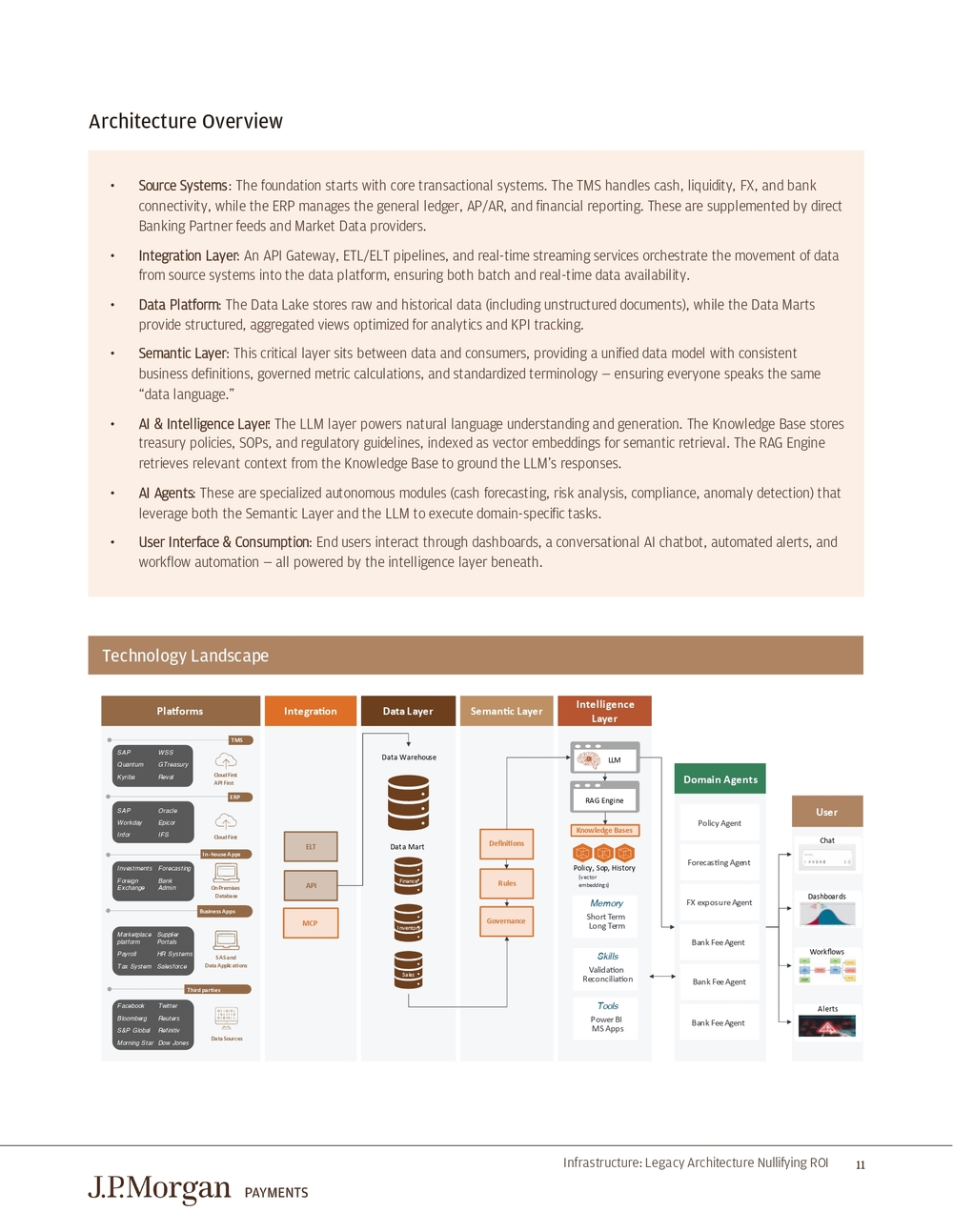
Infrastructure: Legacy Architecture Nullifying ROIArchitecture Overview
• Source Systems: The foundation starts with core transactional systems. The TMS h andles cash, li quidity, FX, and bank
connectivity, while the ERP manages the general ledger, AP/AR, and financial re portin g. These are supplemented by direct
Banking Partner feeds and Market Data providers.
• Integration Layer: An API Gateway, ETL/ELT pipelines, and real-time stre aming service s orchestrate the movement of data
from source systems into the data platform, ensuring both batch and real-time data availab ility.
• Data Platform: The Data Lake stores raw and historical data (including u nstructured d ocuments), while the Data Marts
provide structured, aggregated views optimized for analytics an d KPI tracki ng.
• Semantic Layer: This critical layer sits between data and consumers, p roviding a unified data model with consistent
business definitions, governed metric calculations, and standardi zed terminolog y — ensuring everyone speaks the same
“data language.”
• AI & I ntelligence Layer: The LLM layer powers natural language understand ing and generatio n. Th e Knowledge Base stores
treasury policies, SOPs, and regulatory guidelines, indexed as vector e mbeddi ngs for semantic retrieval. The RAG Engine
retrieves relevant context from the Knowledge Base to ground the LLM’s responses.
• AI Ag ents: These are specialized autonomous modules (cash forecasting, risk analysis, complian ce, anomaly detection) that
leverage both the Semantic Layer and the LLM to execute domain-specific tasks.
• User Interface & Consumption: End users interact through dashboards, a conversation al AI chatbot, automated alerts, and
workflow automation — all powered by the intelligence layer beneath .
Technology Landscape
ERP
In
house Apps TMS Business Apps Third parties Cloud First SAP Workday Infor Oracle Epicor IFS Investments Foreign Exchange Forecasting Bank Admin Marketplace platform Payroll Tax System SAP Quantum Kyriba WSS GTreasury Reval Supplier Portals HR Systems Salesforce Facebook Bloomberg S&P Global Morning Star Twitter Reuters Refinitiv Dow Jones Cloud First API First Platforms Integration API ELT MCP Domain Agents Policy Agent Forecasting Agent FX exposure Agent Bank Fee Agent Bank Fee Agent Bank Fee Agent Semantic Layer Definitions Rules Governance Intelligence Layer Knowledge Bases LLM RAG Engine Short Term Long Term Memory Validation Reconciliation Skills Power BI MS Apps Tools Policy, Sop, History (vector embeddings) User Dashboards Chat Workflows Alerts Data Mart Data Layer Data Warehouse Finance Inventory On Premises Database SAS and Data Applications Data Sources Sales Technology Landscape
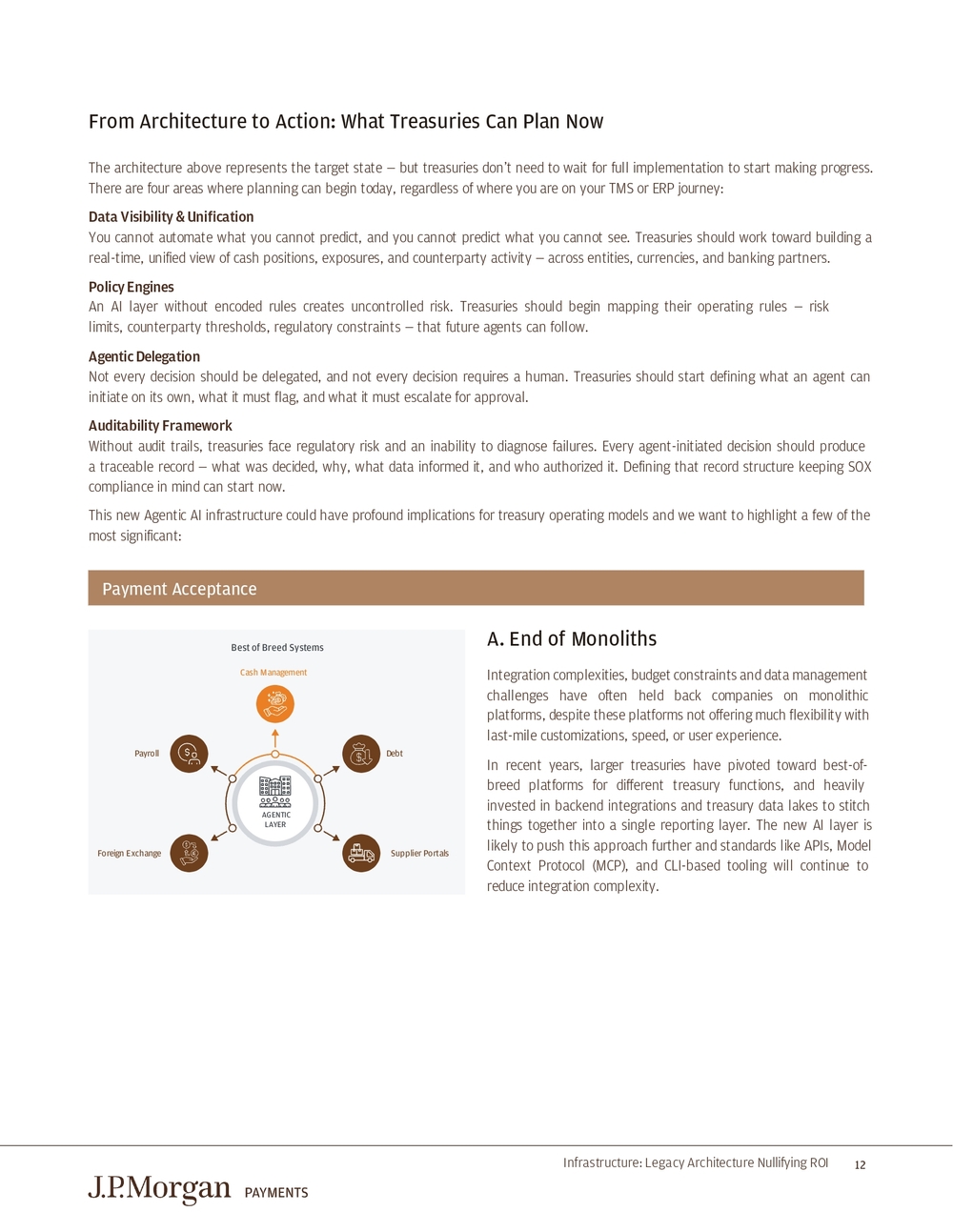
12 Infrastructure: Legacy Architecture Nullifying ROIA. End of MonolithsFrom Archi tecture to Action: What Treasuries Can Plan Now The architecture above represents the target state — but treasuries don’t need to wait for full implementation to start making progress. Ther e are four areas where planning can begin today, regardless of where yo u are on your TMS or ERP journey: D ata Visibility & Unification You cannot automate what you cannot predict, and you cannot predict what you cannot see. Treasuries should work toward building a r eal-time, unified view of cash positions, exposures, and counterparty activity — across entities, currencies, and banking partners. P olicy Engines An AI layer without encoded rules creates uncontrolled risk. Treasuries should begin mapping their operating rules — risk limits, counterparty thresholds, regulatory constraints — that future agents can follow. A gentic Delegation Not every decision should be delegated, and not every decision requires a human . Treasuries should start defining what an agent can initiate on its own, what it must flag, and what it must escalate for approval. A uditability Framework Without audit trails, treasuries face regulatory risk and an inability to diagnose failures. Every agent-initiated decision should produce a traceable record — what was decided, why, what data informed it, and who authorized it. Defining that record structure keeping SOX c ompliance in mind can start now. This ne w Agentic AI infrastructure could have profound implications for treasury operating models and we want to highlight a few of the most significan t: Integration complexities, budget constraints and data management challenges have often held back companies on monolithic platforms, despite these platforms not offering much flexibility with last-mile customizations, speed, or user experience. In recent years, larger treasuries have pivoted toward best-of- breed platforms for different treasury functions, and heavily invested in backend integrations and treasury data lakes to stitch things together into a single reporting layer. The new AI layer is likely to push this approach further and standards like APIs, Model Context Protocol (MCP), and CLI-based tooling will continue to reduce integration complexity. Best of Breed Systems AGENTIC LAYER Cash Management Debt Supplier Portals Payroll Foreign ExchangePayment Acceptance
13
Infrastructure: Legacy Architecture Nullifying ROIB. Rise of Treasury Custom Workflows
In recent years, TMS and ERP migration to cloud and SaaS models
has made last-mile automation and workflow customizations more difficult for corporate treasuries to configure.
However, something fundamental has shifted in the software
development life cycle (SDLC) — and most treasurers haven’t yet connected the dots. AI coding agents — software systems that can independently write, test, and deploy production-grade applications from a simple natural-language prompt — are improving at a pace that has no modern precedent.
This will allow treasuries to capture and automate a number of last-mile processes that have not made it to a TMS or ERP system historically due to resource constraints.
The TMS Isn’t Irrelevant — But Its Role Changes. To be clear, this argument is not that the TMS disappears. Bank connectivity, SWIFT
messaging, payment file generation, core accounting integration, and regulatory infrastructure will continue to require robust, certified, industrial-grade platforms. The TMS will remain the plumbing.
But the workflow layer — the part of treasury technology that defines how a treasurer interacts with data, makes decisions, and manages
exceptions — is the layer that AI coding agents will increasingly own. Think of it like a car. The TMS is the engine — it stays. But the dashboard, the navigation, the driver-assist features? That’s the AI-built workflow layer. And increasingly, it’s going to be custom, dynamic, and defined by the treasurer — not the vendor.Forecasting
Worksheets
Bank
Administration
Dividend
TrackerFX Request
Workflows
Funding
Request
Banking Wallet
Analyzer1
2
34
5
6
!"#ABCD()(DG+,-(. L012+!P-QR
ST89T:9S2#.CR;D+<+0RQ(=.
9T8>?:9S@B(AA+<+BRQD
CSaE:+!"#A%&'%()+%I-./-0.1%2131990#CBcR.D-D(#.+<+dR;#"D(.=
eTae:+!"#A%&'%()+%I-./-0.1%213199BRQD(.=+<+Ig
e>aS:+!"#A%&'%()*+%I-./-0.1%2131992#AR+,R.R"-D(#.Treasury Custom Workflows
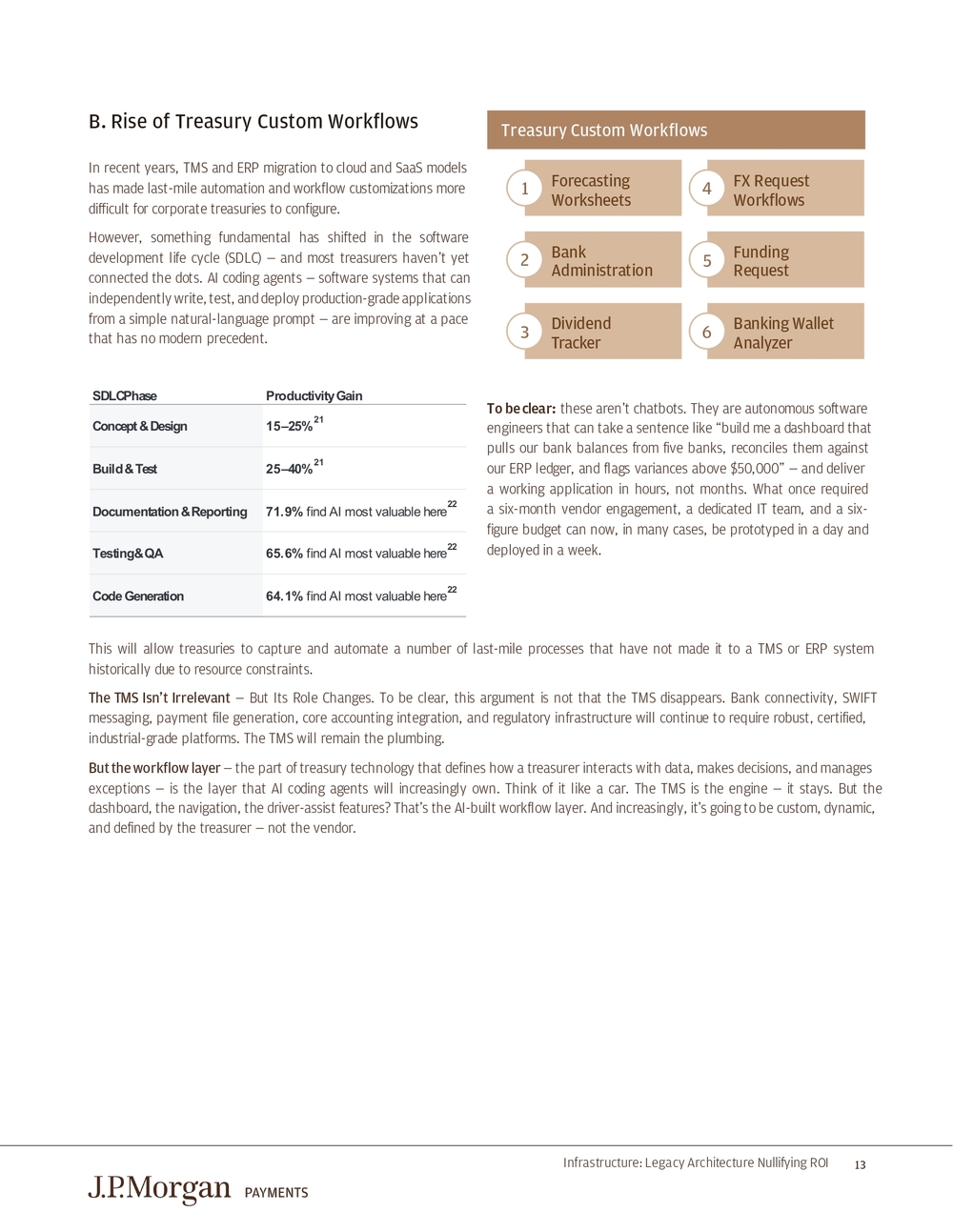
To be clear: these aren’t chatbots. They are autonomous software
engineers that can take a sentence like “build me a dashboard that
pulls our bank balances from five banks, reconciles them against our ERP ledger, and flags variances above $50,000” — and deliver a working application in hours, not months. What once required a six-month vendor engagement, a dedicated IT team, and a six-figure budget can now, in many cases, be prototyped in a day and deployed in a week.
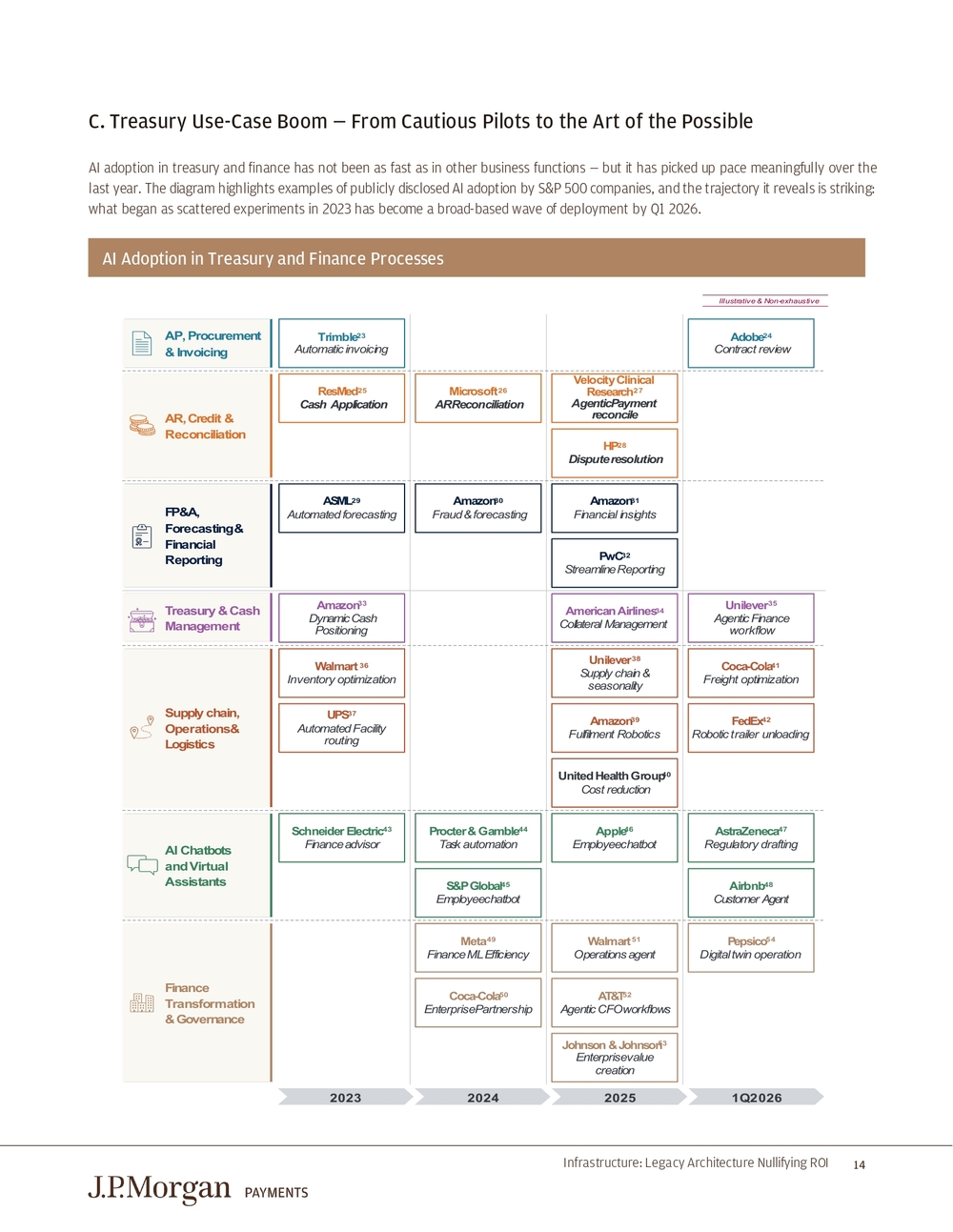
14 Infrastructure: Legacy Architecture Nullifying ROIC. Treasury Use-Case Boom — From Cautious Pilots to the Art of the Possible AI adoption in treasury and finance has not been as fast as in other business functions — but it has picked up pace meaningfully over the last year. The diagram highlights examples of publicly disclosed AI adoption by S&P 500 companies, and the trajectory it reveals is striking: what began as scattered experiments in 2023 has become a broad-based wave of deployment by Q1 2026. !"#!A%C'E%F#EF#GHIJ.LHM#JFA#1EFJFOI#PH%OI..I. !PQ#PH%OLHIRIF'# S#"FT%EOEFU 1PS!Q# 1%HIOJ.'EFU#S# 1EFJFOEJV# WIC%H'EFU ;LCCVM#O<JEFQ# ZCIHJ'E%F.#S#
%UE.'EO. 1EFJFOI# GHJF.?%HRJ'E%F# S#@%TIHFJFOIGHIJ.LHM#S#AJ.<# BJFJUIRIF'!WQ#AHIAE'#S# WIO%FOEVEJ'E%F !"#A<J'C%'.# JFA#aEH'LJV# !..E.'JF'.!""#A%CD%EF*+I+-.L MNOD#A%EF bcbd bcbe bcbf gh#bcbiGHERCVIbd P#%.4D%ER+ELF.ERELS WI.BIAbf !"#A%%CDD()"+),- !;B>bM P#%.4D%T+8.CRDA%ELS !RJN%Fdd 9:LD4ER+;DAO+ <.AE%E.LELS lJVRJH'di !LFL%.C:+.=%E4E>D%E.L mP;dn P#%.4D%T+?DRE"E%:+ C.#%ELS ;O<FIEAIH#oVIO'HEOed ?ELDLR+DTFEA.CBEOH%.%?'bi C.%./,-)()"+),- !RJN%Fdc ?CD#T+I+8.CRDA%ELS PH%O'IH#S#@JRCVIee @DAA+D#%.4D%E.L ;SP#@V%CJVef B4=".:**+ROD%C.% BI'JeM ?ELDLR+ab+B88ERELR: A%OJpA%VJfc BL%C=CEA+<DC%LCAOE=aIV%OE'M#AVEFEOJV# WI.IJHO<bn C0/-+)%1"2P/-+% 4/,-)(/ TPbr R)#D6+/%4/#,(6+),- !RJN%Fdg ?ELDLRED"+ELAESO%A PsAdb c%CD4"EL*+d*=.C%ELS !RIHEOJF#!EHVEFI.de ;.""D%CD"+aDLDS4L% mFEVITIHdr c#==":+RODEL+I+ ADA.LD"E%: !RJN%FdM ?#"8E"4L%+d.C.%ERA mFE'IA#TIJV'<#@H%LCec ;.A%+CT#R%E.L !CCVIei B4=".:**+ROD%C.% lJVRJH'fg e=CD%E.LA+DSL% !GSGfb PSL%ER+;?e+f.CA8".fA t%<F.%F#S#t%<F.%Ffd BL%C=CEA+FD"#+ RCD%E.L!A%CIbe ;.L%CDR%+CFEf mFEVITIHdf PSL%ER+?ELDLR*+ f.CA8".f A%OJpA%VJeg ?CESO%+.=%E4E>D%E.L 1IAoueb d.C.%ER+%CDE"C+#L".DTELS !.'HJvIFIOJen dS#"D%.C:+TCD8%ELS !EHCFCer ;#A%.4C+PS*L% PIC.EO%fe 9ESE%D"+%fEL+.=*CD%E.LAI Adoption in Treasury and Finance Processes
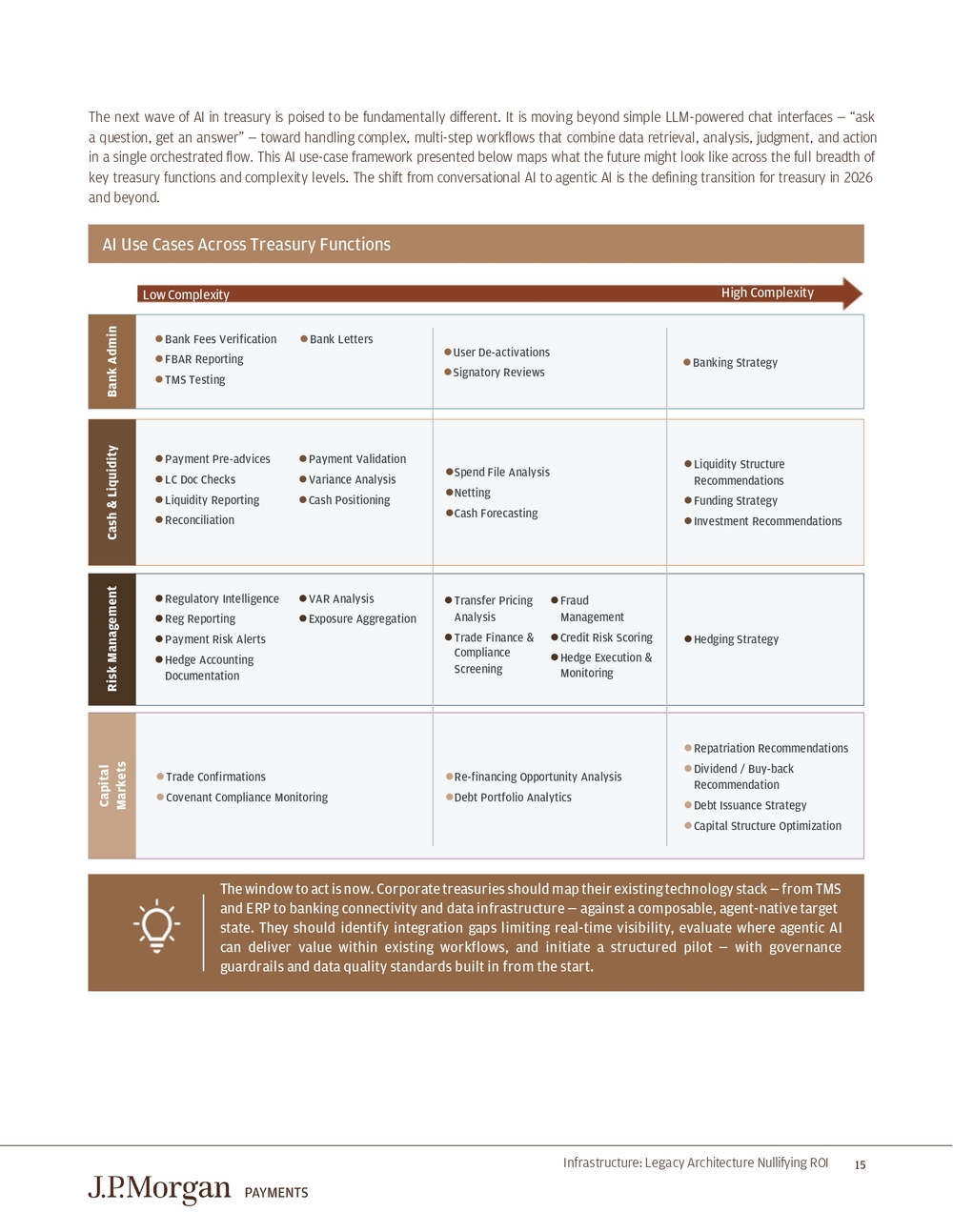
15 Infrastructure: Legacy Architecture Nullifying ROIThe next wave of AI in treasury is poised to be fundamentally different. It is moving beyond simple LLM-powered chat interfaces — “ask a question, get an answer” — toward handling complex, multi-step workflows that combine data retrieval, analysis, judgment, and action in a single orchestrated flow. This AI use-case framework presented below maps what the future might look like across the full breadth of key treasury functions and complexity levels. The shift from conversational AI to agentic AI is the defining transition for treasury in 2026 and beyond. The window to act is now. Corp orate treasuries should map their existing technology stack — from TMS and ERP to bankin g c onnectivity and data infrastructure — against a composable, agent-native target state. They should identify integration gaps limiting real-time visibility, evaluate where agentic AI can deliver value within existing workflows, and initiate a structured pilot — with governance guardrails and data quality standards built in from the start. Cash & LiquiditylPayment Pre-advices lLC Doc Checks lLiquidity Reporting lReconciliationlPayment Validation lVariance Analysis lCash PositioninglSpend File Analysis lNetting lCash ForecastinglLiquidity Structure Recommendations lFunding Strategy lInvestment RecommendationsBank AdminlBank Fees Verification lFBAR Reporting lTMS TestinglBank Letters lUser De-activations lSignatory ReviewslBanking StrategyRisk ManagementlRegulatory Intelligence lReg Reporting lPayment Risk Alerts lHedge Accounting DocumentationlVAR Analysis lExposure Aggregation lTransfer Pricing Analysis lTrade Finance & Compliance ScreeninglFraud Management lCredit Risk Scoring lHedge Execution & MonitoringlHedging Strategy lTrade Confirmations lCovenant Compliance MonitoringlRe-financing Opportunity Analysis lDebt Portfolio AnalyticslRepatriation Recommendations lDividend / Buy-back Recommendation lDebt Issuance Strategy lCapital Structure OptimizationCapital MarketsAI Use Cases Across Treasury Functions Low Complexity Low Complexity High Complexity
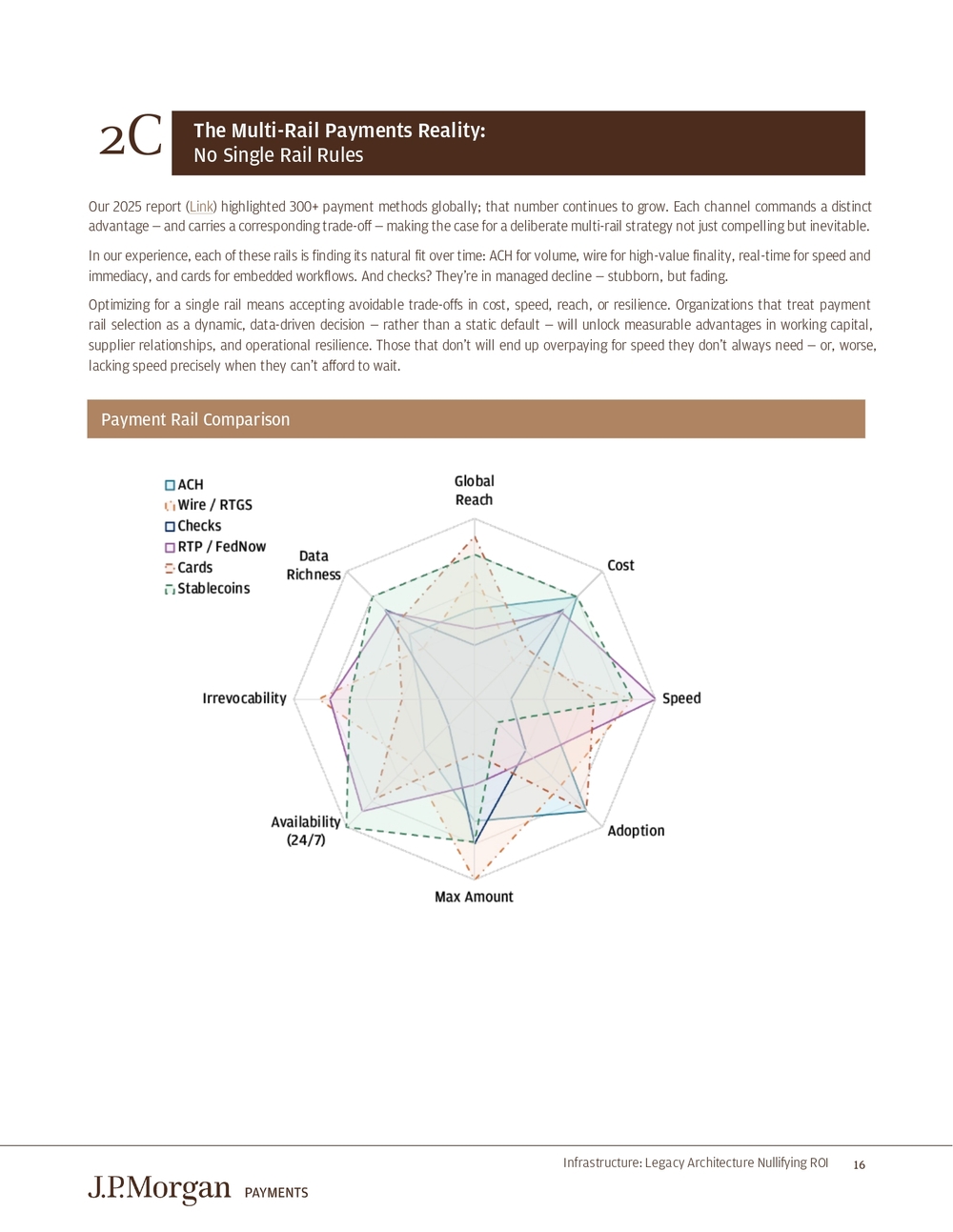
16 Infrastructure: Legacy Architecture Nullifying ROIPayment Rail ComparisonOur 2025 report (Link) highlighted 300+ payment methods globally; that number continues to grow. Each channel commands a distinct advantage — and carries a corresponding trade-off — making the case for a deliberate multi-rail strategy not just compelling but inevitable. In our experience, each of these rails is finding its natural fit over time: ACH for volume, wire for high-value finality, real-time for speed and immediacy, and cards for embedded workflows. And checks? They’re in managed decline — stubborn, but fading. Optimizing for a single rail means accepting avoidable trade-offs in cost, speed, reach, or resilience. Organizations that treat payment rail selection as a dynamic, data-driven decision — rather than a static default — will unlock measurable advantages in working capital, supplier relationships, and operational resilience. Those that don’t will end up overpaying for speed they don’t always need — or, worse, lacking speed precisely when they can’t afford to wait.2CThe Multi-Rail Payments Reality: No Single Rail Rules
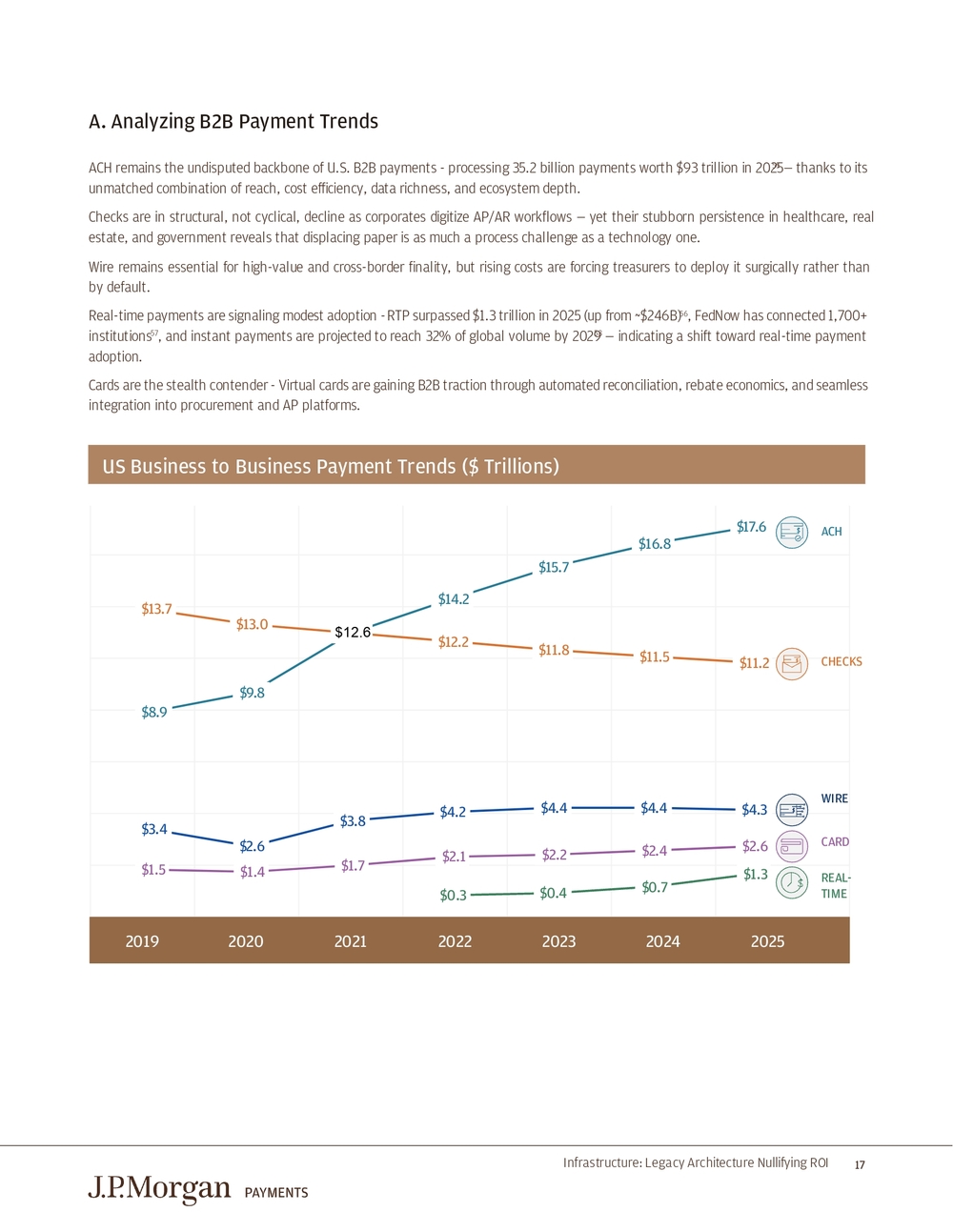
17 Infrastructure: Legacy Architecture Nullifying ROIA. Analyzing B2B Payment Trends ACH remains the undisputed backbone of U.S. B2B payments - processing 35.2 billion payments worth $93 trillion in 202555 — thanks to its unmatched combination of reach, cost efficiency, data richness, and ecosystem depth. Checks are in structural, not cyclical, decline as corporates digitize AP/AR workflows — yet their stubborn persistence in healthcare, real estate, and government reveals that displacing paper is as much a process challenge as a technology one. Wire remains essential for high-value and cross-border finality, but rising costs are forcing treasurers to deploy it surgically rather than by default. Real-time payments are signaling modest adoption - RTP surpassed $1.3 trillion in 2025 (up from ~$246B)56, FedNow has connected 1,700+ institutions57, and instant payments are projected to reach 32% of global volume by 202958 — indicating a shift toward real-time payment adoption.Cards are the stealth contender - Virtual cards are gaining B2B traction through automated reconciliation, rebate economics, and seamless integration into procurement and AP platforms. US Business to Business Payment Trends ($ Trillions) Why haven’t virtual cards lived up to their potential for B2B payments? $8.9 $9.8 $12.6 $14.2 $15.7 $16.8 $17 .6 $13.7 $13.0 $12.6 $12.2 $11.8 $11.5 $11.2 $3.4 $2.6 $3.8 $4.2 $4.4 $4.4 $4.3 $1.5 $1.4 $1.7 $2.1 $2.2 $2.4 $2.6 $0.3 $0.4 $0.7 $1.3 ACH CHECKS WIRE CARD REAL
TIME U.S. B2B in $ Trillions by Payment Type 2019 2020 2021 2022 2023 2024 2025
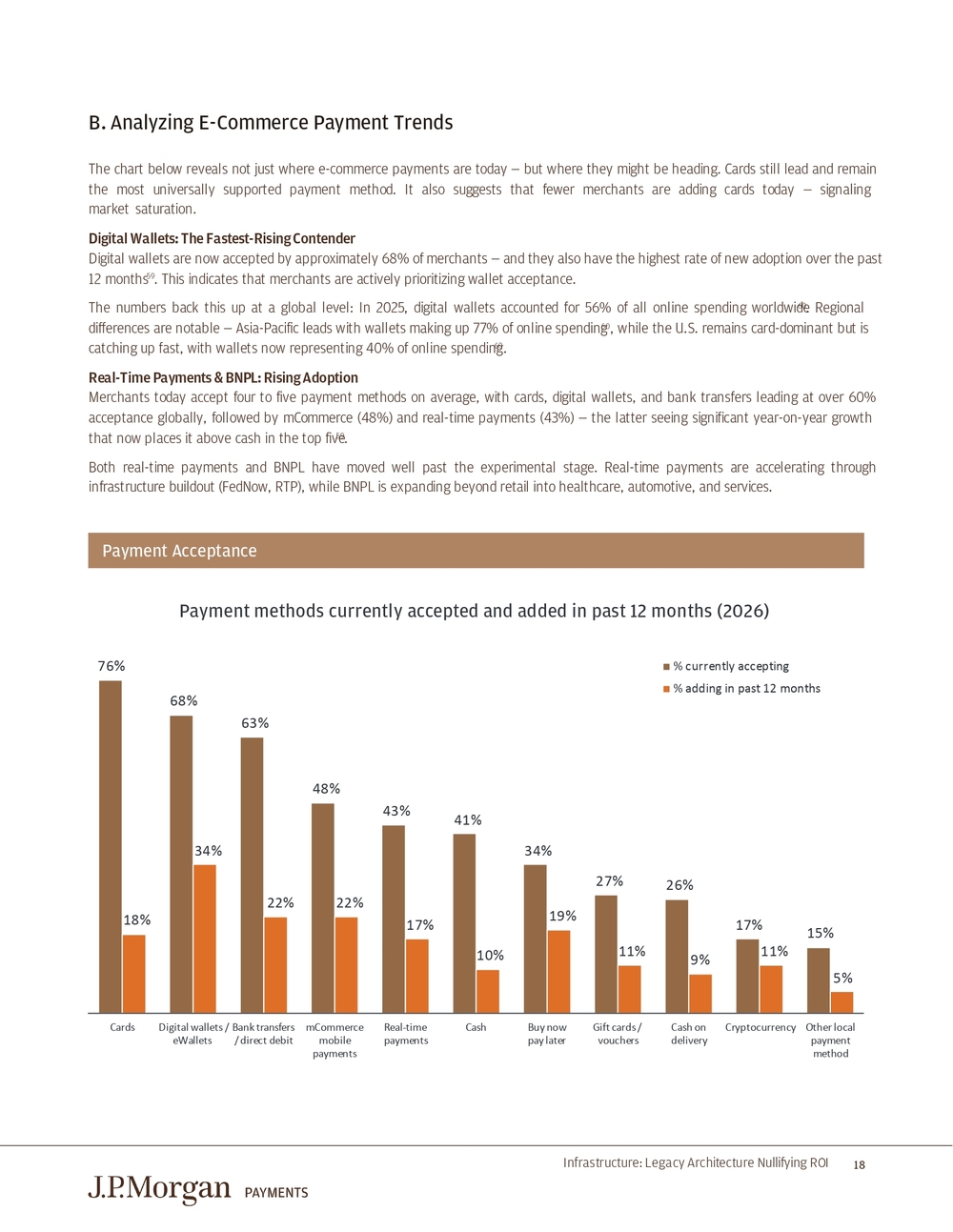
18 Infrastructure: Legacy Architecture Nullifying ROIB. Analyzing E-Co mmerce Payment Trends The chart below reveals not just where e-commerce payments are today — but where they might be heading. Cards still lead and remain the most universally supported payment method. It also suggests that fewer merchants are adding cards today — signaling market saturation. Digital Wallets: The Fastest-Rising Contender Digital wallets are now accepted by approximately 68% of merchants — and they also have the highest rate of new adoption over the past 12 months59. This indicates that merchants are actively prioritizing wallet acceptance. The numbers back this up at a global level: In 2025, digital wallets accounted for 56% of all online spending worldwide60. Regional differences are notable — Asia-Pacific leads with wallets making up 77% of online spending60, while the U.S. remains card-dominant but is catching up fast, with wallets now representing 40% of online spending60. R eal-Time Payments & BNPL: Rising Adoption Mer chants today accept four to five payment methods on average, with cards, digital wallets, and bank transfers leading at over 60% ac ceptance globally, followed by mCommerce (48%) and real-time payments (43%) — th e latter seeing significant year-on-year growth that now places it above cash in the top five59. Both real-time payments and BNPL have moved well past the experimental stage. Real-time payments are accelerating through infrastructure buildout (FedNow, RTP), while BNPL is expanding beyond retail into h ealthcare, automotive, and services. Payment Acceptance Payment methods currently accepted and added in past 12 months (2026) 76% 68% 63% 48% 43% 41% 34% 27% 26% 17% 15% 18% 34% 22% 22% 17% 10% 19% 11% 9% 11% 5% Cards Digital wallets / eWallets Bank transfers / direct debit mCommerce mobile payments Real-time payments Cash Buy now pay later Gift cards / vouchers Cash on delivery Cryptocurrency Other local payment method % currently accepting % adding in past 12 months
19
Infrastructure: Legacy Architecture Nullifying ROIThe digital currency landscape has reached an inflection point that treasuries can no longer ignore. It is shifting from pilots to production.
B. S tablecoins:
$320+ Billion and Growing —
But Read the Fine PrintFour distinct forms of digital money — stablecoins, deposit tokens, CBDCs, and cryptocurrencies — are evolving with blockchain infrastructure
to r
eshape how value moves globally. Each carries distinct implications for treasury, and none can be dismissed.
A
. Deposit Tokens: The Regulated Bridge Between Old and New
Among
the most consequential developments for corporate treasury is the emergence of bank-issued deposit tokens. For
example, Kinexys by J.P. Morgan recently launched its deposit token (JPM Coin) and is available to its eligible clients on public
blockchains, starting with Coinbase’s Base (Ethereum Layer-2) and being expanded to additional blockchains such as the Canton Network
— marking a decisive move from pilot to production.
These tokens are bank-issued deposit liabilities, operate within existing compliance and regulatory frameworks, and can be treated as
tr
aditional deposits on institutional balance sheets.
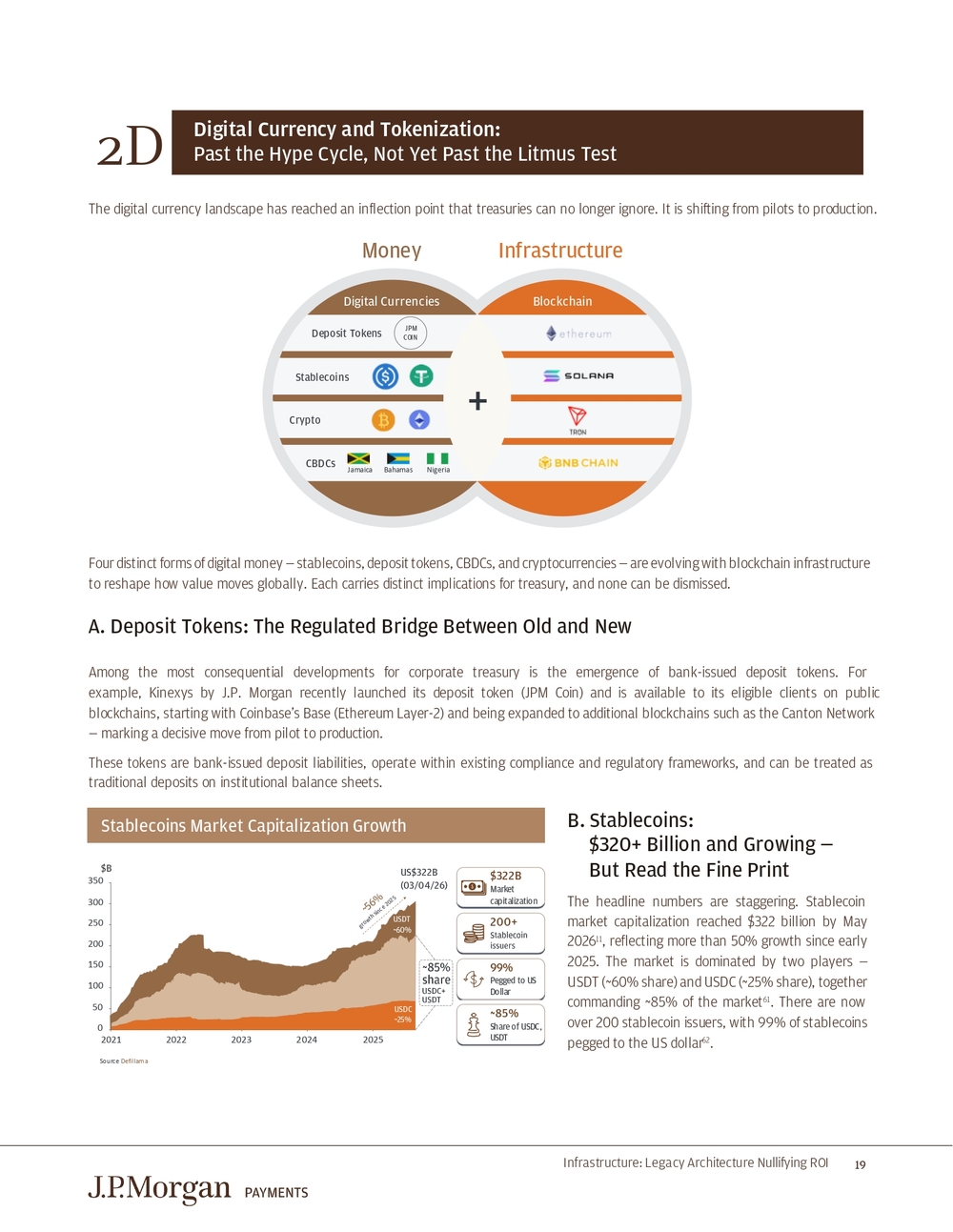
The headline numbers are staggering. Stablecoin
market capitalization reached $322 billion by May 2026
11, reflecting more than 50% growth since early
2025. The market is dominated by two players — USDT (~60% share) and USDC (~25% share), together commanding 85% of the market
61. There are now
over 200 stablecoin issuers, with 99% of stablecoins pegged to the US dollar
62.Stablecoins Market Capitalization Growth2DDigital Currency and Tokenization:
Past the Hype Cycle, Not Yet Past the Litmus Test
+
Digital Currencies
Blockchain
Deposit Tokens
CBDCs
Nigeria
Bahamas
Jamaica
Crypto
Stablecoins
JPM
COIN
Money
Infrastructure
050100150200250300350
2021 2022 2023 2024 2025
200+200+
$3$3222B2B
Market
capitalization
56%
growth since 2025$B
USDC
8855%%
Share of USDC,USDT
99%99%
Pegged to USDollar25%USDT60%US$322B(03/04/26)
Source Defillama
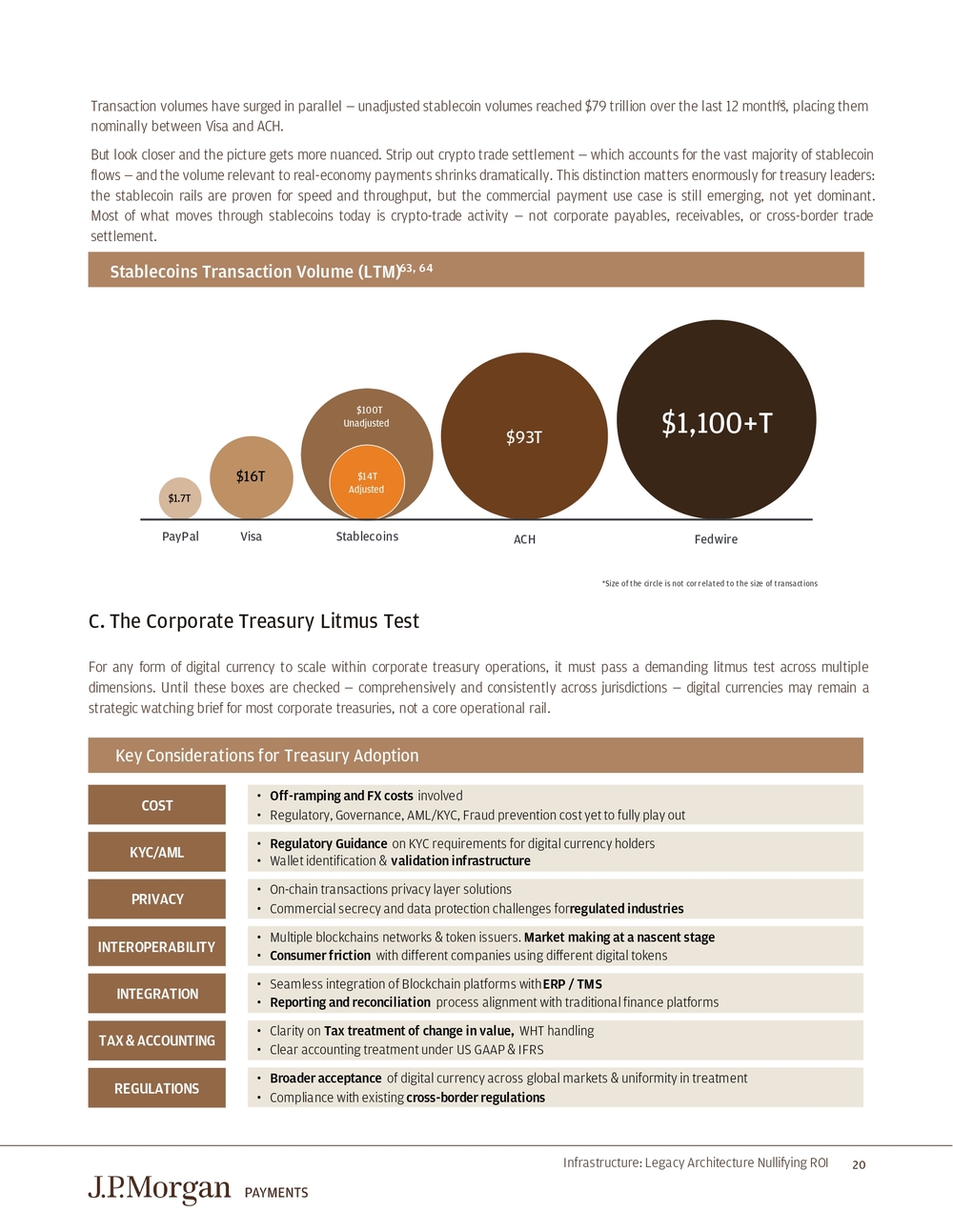
20 Infrastructure: Legacy Architecture Nullifying ROITransaction volumes have surged in parallel — unadjusted stablecoin volumes reached $79 trillion ove r the last 12 months63, placing them nominally between Visa and ACH. But look closer and the picture gets more nuanced. Strip out crypto trade settlement — which accounts for the vast majority of stablecoin flows — and the v olume relevant to real-economy payments shrinks dramatically. This distinction matters enormously for treasury leaders: the stablecoin rails are proven for speed and throughput, but the commercial payment use case is still emerging, not yet dominant. Most of what moves through stablecoins today is crypto-trade activity — not corporate payables, receivables, or cross-border trade settlement. For any form of digital currency to scale within corporate treasury operations, it must pass a demanding litmus test across multiple dimensions. Until these boxes are checked — comprehensively and consistently across jurisdictions — digital currencies may remain a strategic watching brief for most corporate treasuries, not a core operational rail.C. The Corporate Treasury Litmus TestStablecoins Transaction Volume (LTM)63, 64 Key Considerations for Treasury Adoption COST PRIVACY INTEGRATIONKYC/AML INTEROPERABILITY TAX & ACCOUNTING REGULATIONS•Off-ramping and FX costs involved • Regulatory, Governance, AML/KYC, Fraud prevention cost yet to fully play out •Regulatory Guidance on KYC requirements for digital currency holders • Wallet identification & validation infrastructure • On-chain transactions privacy layer solutions • Commercial secrecy and data protection challenges for regulated industries • Multiple blockchains networks & token issuers. Market making at a nascent stage •Consumer friction with different companies using diffe rent digital tokens • Seamless integration of B lockchain platforms with ERP / TMS •Reporting and reconciliation process alignment with traditional finance platforms • Clarity on Tax treatment of change in value, WHT handling • Clear accounting treatment under US GAAP & IFRS •Broader acceptance of digital c urrency across global mark ets & uniformity in treatm ent • Compliance with existing cross-border regulations$1.7T$16T $14T Adjusted$100T Unadjusted $1,100+T$93T PayPal Visa ACH Fedwire Stablecoins *Size of the circle is not correlated to the size of transactions Source: Visa on chain analytics
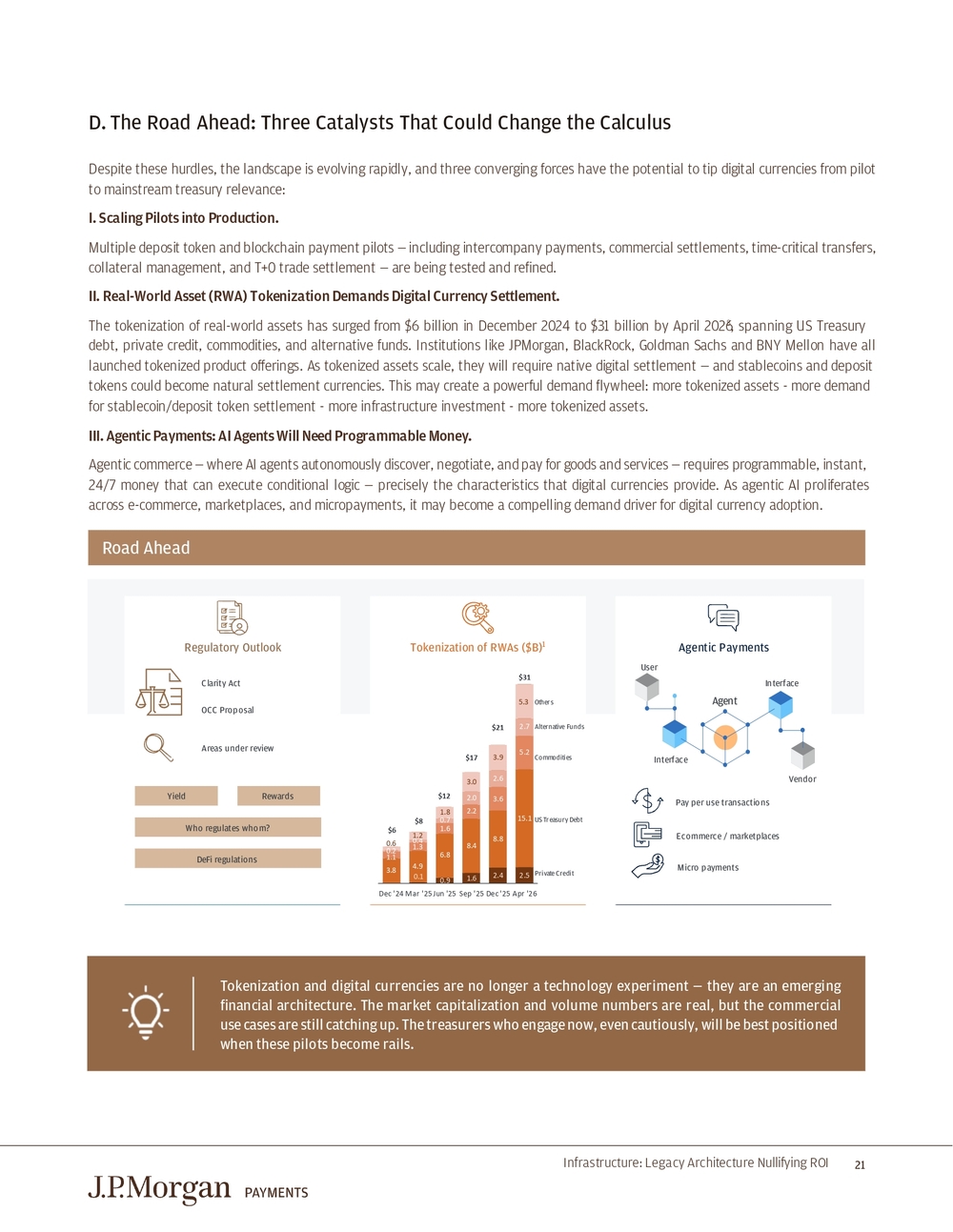
21 Infrastructure: Legacy Architecture Nullifying ROID. The Road Ahead: Three Catalysts That Could Change the Calculus Despite these hurdles, the landscape is evolving rapidly, and three converging forces have the potential to tip digital currencies from pilot to mainstream treasury relevance: I. Scaling Pilots into Production. Multiple deposit token and blockchain payment pilots — including intercompany payments, commercial settlements, time-critical transfers, c ollateral management, and T+0 trade settlement — are being tested and refined. II. Real-World Asset (RWA) Tokenization Demands Digital Currency Settlement. The tokenization of real-world assets has surged from $6 billion in December 2024 to $31 billion by April 20268, spanning US Treasury debt, private credit, commodities, and alternative funds. Institutions like JPMorg an, BlackRock, Goldman Sachs and BNY Mellon have all launched tokenized product offerings. As tokenized assets scale, they will require native digital settlement — and stablecoins and deposit tokens could become natural settlement currencies. This may create a powerful demand flywheel: more tokenized assets - more demand f or stablecoin/deposit token settlement - more infrastructure investment - more tokenized assets. III. A gentic Payments: AI Agents Will Need Programmable Money. Agentic commerce — where AI agents autonomously discove r , negotiate, and pay for goods and services — requires programmable, instant, 2 4/7 money that can execute conditional logic — precisely the characteristics that digital currencies provide. As agentic AI proliferates acr oss e-commerce, marketplaces, and micropayments, it may become a compelling demand driver for digital currency adoption. Tokenization and digital currencies are no longer a technology experiment — they are an emerging financial architecture. The market capitalization and volume numbers are real, but the commercial use cases are still catching up. The treasurers who engage now, even cautiously, will be best positioned when these pilots become rails. Road Ahead Agentic Payments Regulatory Outlook Clarity Act OCC Proposal Areas under review Yield Rewards Who regulates whom? DeFi regulations User Vendor Interface Agent Interface Micro payments Pay per use transactions Ecommerce / marketplaces $6 $8 $12 $17 $21 $31 0.1 0.9 1.6 2.4 2.5 3.8 4.9 6.8 8.4 8.8 15.1 1.1 1.3 1.6 2.2 3.6 5.2 0.2 0.4 0.7 2.0 2.6 2.7 0.6 1.2 1.8 3.0 3.9 5.3 Dec '24 Mar '25 Jun '25 Sep '25 Dec '25 Apr '26 US$bn 4 Tokenization of RWAs ($B) 1 Private Credit US Treasury Debt Commodities Alternative Funds OthersRoad Ahead
Intelligence:
The Next Frontier03

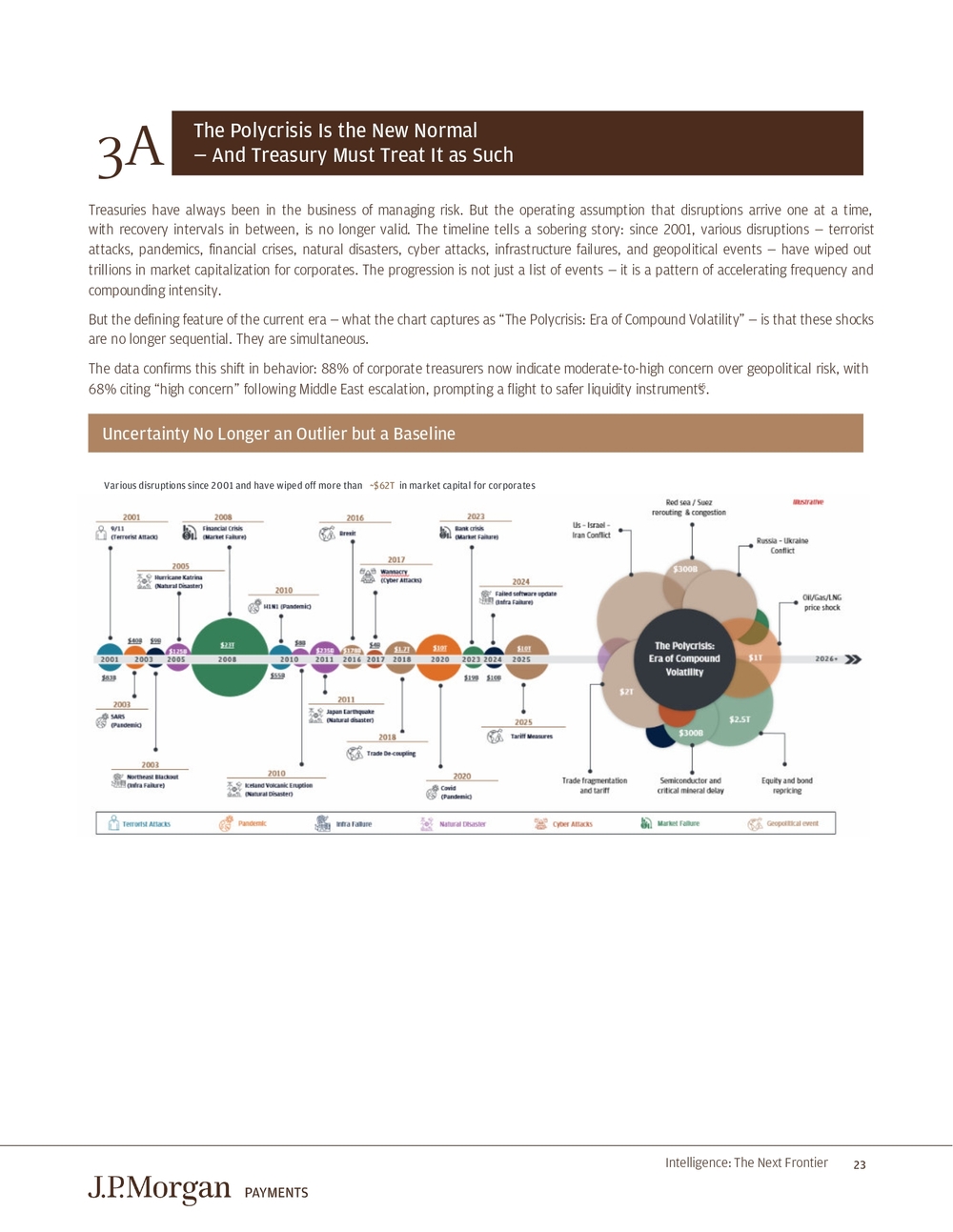
23 Intelligence: The Next Fr ontierTreasuries have always been in the business of managing risk. But the operating assumption that disruptions arrive one at a time, with recovery intervals in between, is no longer valid. The timeline tells a sobering story: since 2001, various disruptions — terrorist attacks, pandemics, financial crises, natural disasters, cyber attacks, infrastructure failures, and geopolitical events — have wiped out trillions in market capitalization for corporates. The progression is not just a list of events — it is a pattern of accelerating frequency and compounding intensity. But the defining feature of the current era — what the chart captures as “The Polycrisis: Era of Compound Volatility” — is that these shocks are no longer sequential. They are simultaneous. The data confirms this shift in behavior: 88% of corporate treasurers now indicate moderate-to-high concern over geopolitical risk, with 68% citing “high concern” following Middle East escalation, prompting a flight to safer liquidity instruments 65. Uncertainty no longer an outlier but a baseline Various disruptions since 2001 and have wiped off more than ~$62T in market capital for corporates Uncertainty No Longer an Outlier but a Baseline3AThe Polycrisis Is the New Normal — And Treasury Must Treat It as Such
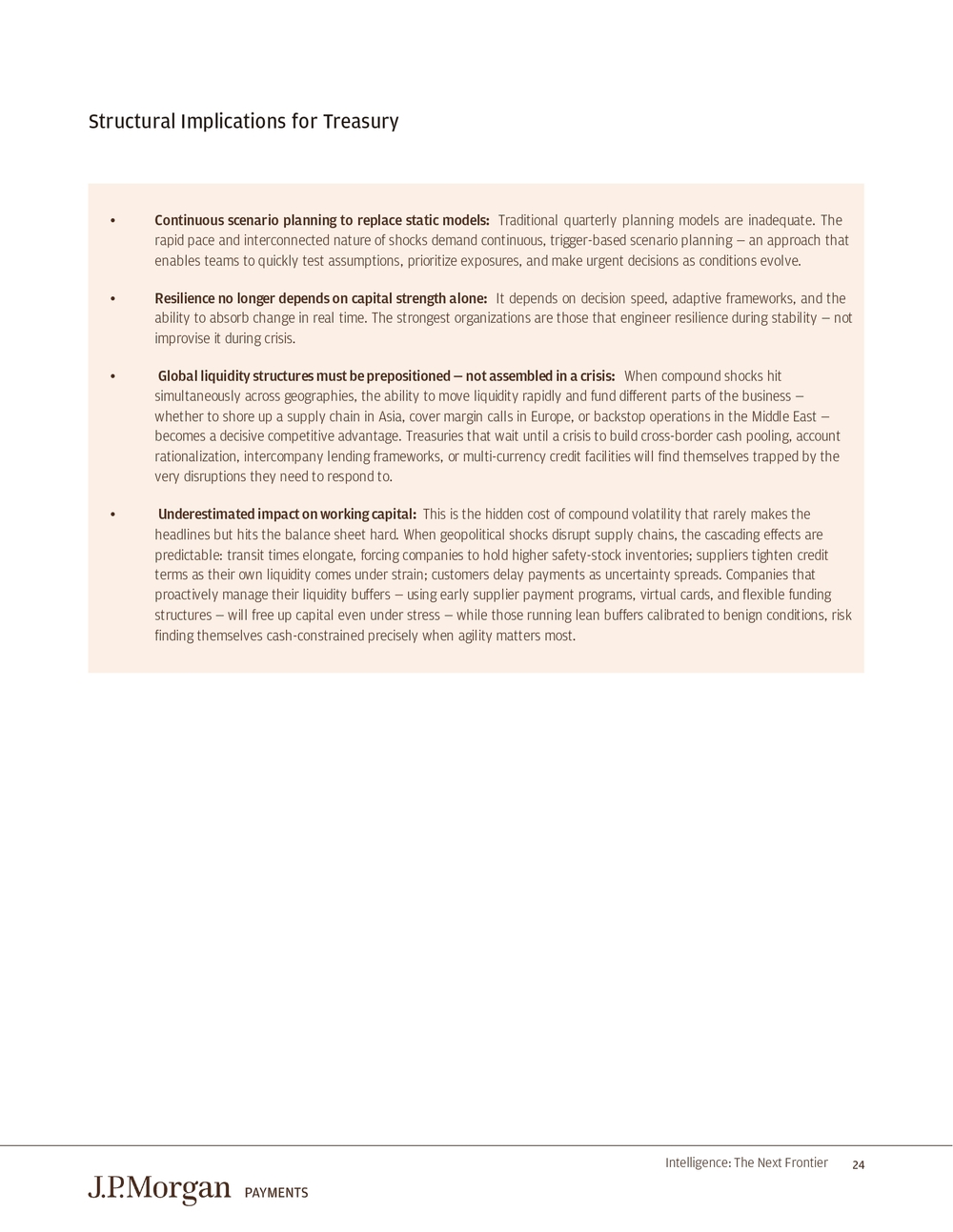
24 Intelligence: The Next Fr ontierStructural Implications for Treasury • Continuous scenario planning to replace static models: Traditional quarterly p lanning models are inadequate. The rapid pace and interconnected nature of shocks demand continuous, trigger-based scenario planning — an approach that enables teams to quickly test assumptions, prioritize exposures, and make urgent decisions as conditions evolve. • Resilience no longer depends on capital strength alone: It depends on decision speed, adaptive frameworks, and the ability to absorb change in real time. The strongest organizations are those that engineer resilience during stability — not improvise it during crisis. • Global liquidity structures must be prepositioned — not assembled in a crisis: When compound shocks hit simul taneously across geographies, the ability to move liquidity rapidly and fund different parts of the business — whether to shore up a supply chain in Asia, cover margin calls in Europe, or backstop operations in the Middle East — becomes a decisive competitive advantage. Treasuries that wait until a crisis to build cross-border cash pooling, account rationalization, intercompany lending frameworks, or multi-currency credit facilities will find themselves trapped by the very disruptions they need to respond to. • Underestimated impact on working capital: This is the hidden cost of compound volatility that rarely makes the headlines but hits the balance sheet hard. When geopolitical shocks disrupt supply chains, the cascading effects are predictable: transit times elongate, forcing companies to hold higher safety-stock inventories; suppliers tighten credit terms as their own liquidity comes under strain; customers delay payments as uncertainty spreads. Companies that proactively manage their liquidity buffers — using early supplier payment programs, virtual cards, and flexible funding structures — will free up capital even under stress — while those running lean buffers calibrated to benign conditions, risk finding themselves cash-constrained precisely when agility matters most.
25
Intelligence: The Next F rontier3BRegulatory Intelligence:
From Reactive Compliance to Strategic Foresight
The regulatory landscape facing treasury and payments is not just expanding — it is converging across multiple domains simultaneously,
creating a complex, multi-jurisdictional web that demands proactive intelligence rather than reactive compliance.
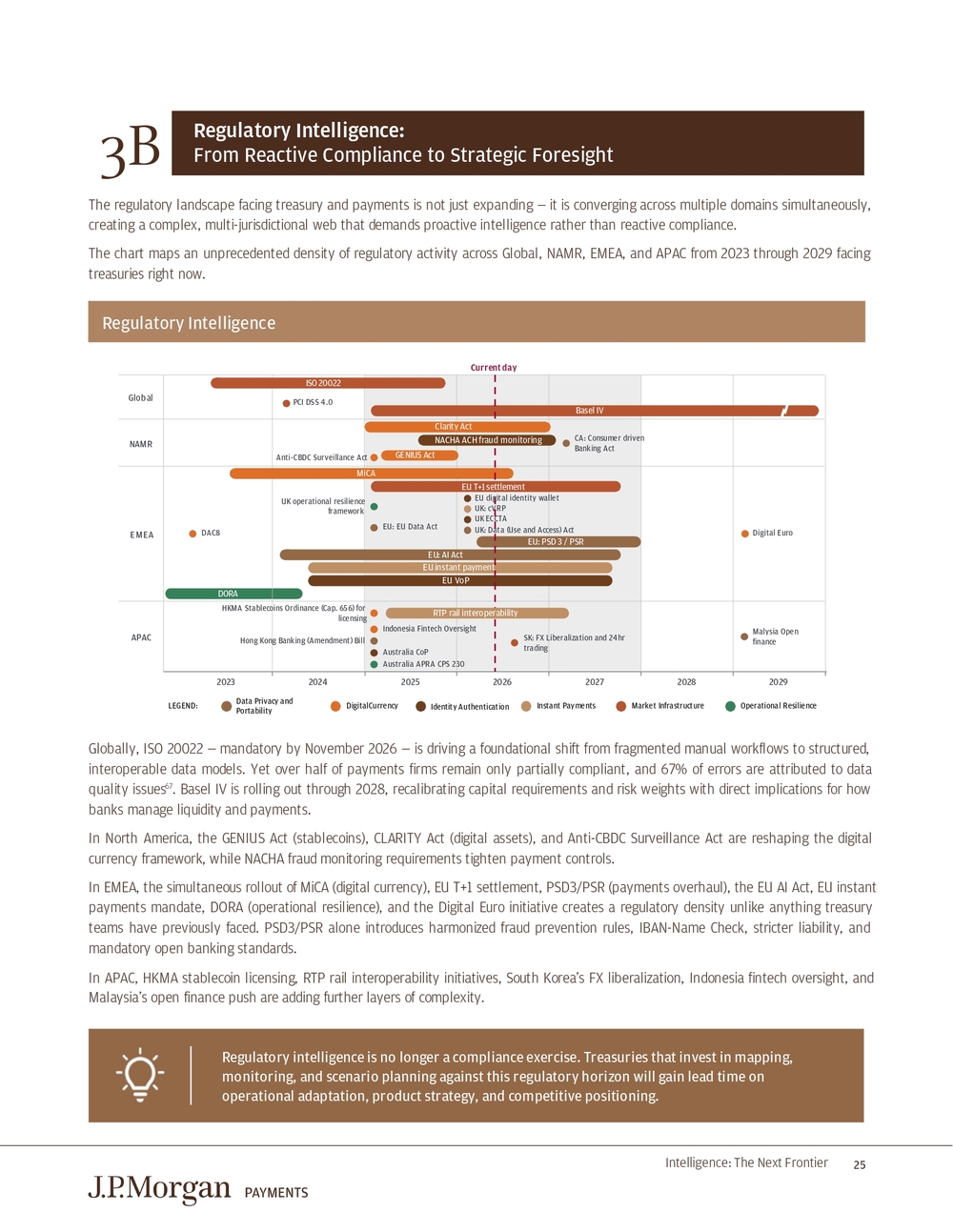
The chart maps an unprecedented density of regulatory activity across Global, NAMR, EMEA, and APAC from 2023 through 2029 facing
treasuries right now.
Globally, ISO 20022 — mandatory by November 2026 — is driving a foundational shift from fragmented manual workflows to structured,
interoperable data models. Yet over half of payments firms remain only partially compliant, and 67% of errors are attributed to data quality issues
67. Basel IV is rolling out through 2028, recalibrating capital requirements and risk weights with direct implications for how
banks manage liquidity and payments.
In North America, the GENIUS Act (stablecoins), CLARITY Act (digital assets), and Anti-CBDC Surveillance Act are reshaping the digital
currency framework, while NACHA fraud monitoring requirements tighten payment controls.
In EMEA, the simultaneous rollout of MiCA (digital currency), EU T+1 settlement, PSD3/PSR (payments overhaul), the EU AI Act, EU instant
payments mandate, DORA (operational resilience), and the Digital Euro initiative creates a regulatory density unlike anything treasury teams have previously faced. PSD3/PSR alone introduces harmonized fraud prevention rules, IBAN-Name Check, stricter liability, and mandatory open banking standards.
In APAC, HKMA stablecoin licensing, RTP rail interoperability initiatives, South Korea’s FX liberalization, Indonesia fintech oversight, and
Malaysia’s open finance push are adding further layers of complexity.
Regulatory intelligence is no longer a compliance exercise. Treasuries that invest in mapping,
monitoring, and scenario planning against this regulatory horizon will gain lead time on
operational adaptation, product strategy, and competitive positioning.
Regulatory Intelligence
NAMR
EMEA
APACGlobal
DORA
2023 2024 2025 2026 2027 2028 2029DAC8 Digital EuroAnti-CBDC Surveillance ActPCI DSS 4.0ISO 20022
Basel IV
Indonesia Fintech Oversight
SK: FX Liberalization and 24hr
tradingMalysia Openfinance
Hong Kong Banking (Amendment) BillCA: Consumer drivenBanking Act
Australia CoPMiCA
EU instant paymentUK: cVRP
EU: PSD 3 / PSRUK: Data (Use and Access) ActEU: EU Data Act
EU: AI Act
EUVoPEU digital identity wallet
UK ECCTAUK operational resilience
framework
Australia APRA CPS 230Current day
NACHA ACH fraud monitoringClarity Act
GENIUS Act
EU T+1 settlement
HKMA Stablecoins Ordinance (Cap. 656) for
licensingRTP rail interoperability
Digital Currency Operational ResilienceData Privacy and
PortabilityIdentity Authentication Market Inf rastructu re Instant Payments LEGEND:
26
Intelligence: The Next Fr ontier3C
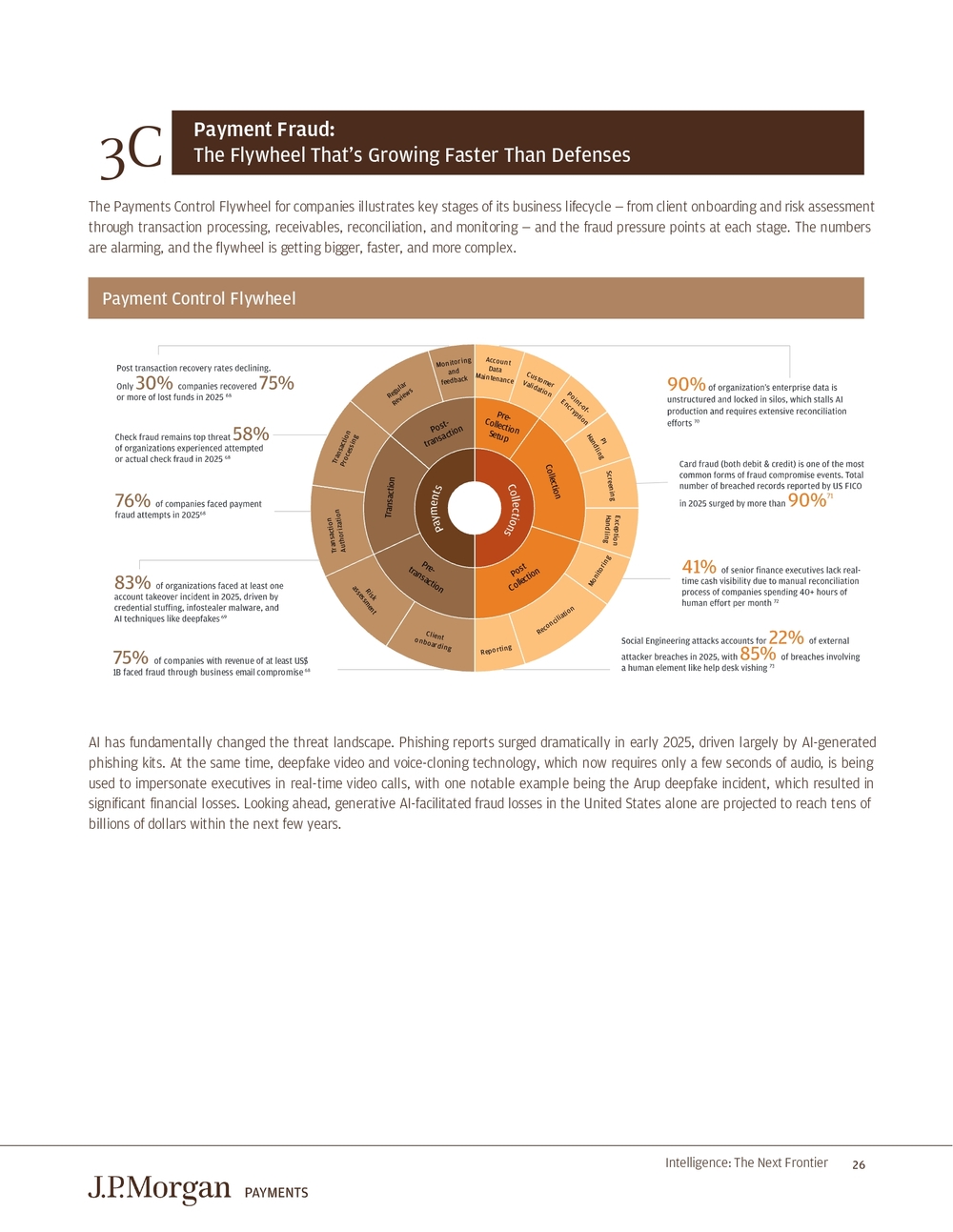
The Payments Control Flywheel for companies illustrates key stages of its business lifecycle — from client onboarding and risk assessment
through transaction processing, receivables, reconciliation, and monitoring — and the fraud pressure points at each stage. The numbers are alarming, and the flywheel is getting bigger, faster, and more complex.
AI has fundamentally changed the threat landscape. Phishing reports surged dramatically in early 2025, driven largely by AI-generated
phishing kits. At the same time, deepfake video and voice-cloning technology, which now requires only a few seconds of audio, is being used to impersonate executives in real-time video calls, with one notable example being the Arup deepfake incident, which resulted in significant financial losses. Looking ahead, generative AI-facilitated fraud losses in the United States alone are projected to reach tens of billions of dollars within the next few years. Payment Control FlywheelPayment Fraud:
The Flywheel That’s Growing Faster Than Defenses
Account
Data
MaintenanceCustomer
Validation
Point-of-
Encryption
PIHandling
ScreeningExceptionHandling
Monitoring
Reconciliation
ReportingClient
onboardingRiskassessment
Transaction AuthorizationTransaction
ProcessingRegular
ReviewsMonitoring
and
feedback
Post-
transaction
Transaction
Pre-transactionPost
CollectionCollectionPre-Collection
Setup
75% of companies with revenue of at least US$
1B faced fraud through business email compromise68
27 Intelligence: The Next F rontierThe problem extends across the entire flywheel. Layered Risks Will Require Layered Controls Corporate treasury departments may be approaching their own Skynet moment. Not the civilization-ending kind (we hope), but the philosophical one: the very technology being deployed to manage risk is simultaneously creating entirely new categories of risk that didn’t exist eighteen months ago. The tool and the threat are the same thing. The Multilayered Risks and Controls framework below captures this paradox — and it should sit on the desk of every CFO and treasurer navigating the AI era. Compounding Risk and Multi-Layered ControlsKey Threat Stage Scale of Problem Master Data IntegrityMaster Data90% of organizations’ enterprise data is unstructured and locked in silos, which stalls AI production and requires extensive reconciliation efforts 69 Card fraud & identity theftReceivables / IdentityBreached records reported by US FICO on card fraud surged by more than 90% in 2025 70 Manual processes Reconciliation52% of mid-sized firms manually gather/consolidate forecasting data71 41% of senior finance executives lack real-time cash visibility due to manual reconciliation processes 72 BEC / Wire fraudTransaction Processing76% of companies faced payment fraud attempts in 202567 Account takeover Pre-Transaction / Risk 83% of organizations faced at least one account takeover incident in 202568 Business email compromiseClient Onboarding75% of companies with revenue of at least US$1 billion faced fraud through business email compromise 67 Help desk manipulationMonitoring / Social Engineering22% of external attacker breaches in 2025, with 85% of breaches involving a human element 73 Check Fraud Check Processing 58% of organizations experienced attempted or actual check fraud67Risk Areas GuardrailsHigh-velocity ScammingSynthetic Identity Language checksAccess management Maker-checker Confidence scoring Anomaly DetectionLiveness checkMulti-factor authenticationIntent Poisoning Data Security Human-over-The-Loop Red-teamingModel GovernanceHallucination Training Data Manipulation RAG audit trailModel Drift Explainable AI (XAI)Model inversion Cascading failures Unauthorized access Account Takeovers Insider Fraud Transaction limits Call-back Verification Identity Validation RLHF safety tuningDeepfakes Safe Sandbox TestingModel Bias Role Abuse Business Email compromiseSocial engineering Prompt Injection Micro depositsAI-Amplified Risk AI Model RiskTraditional Risk
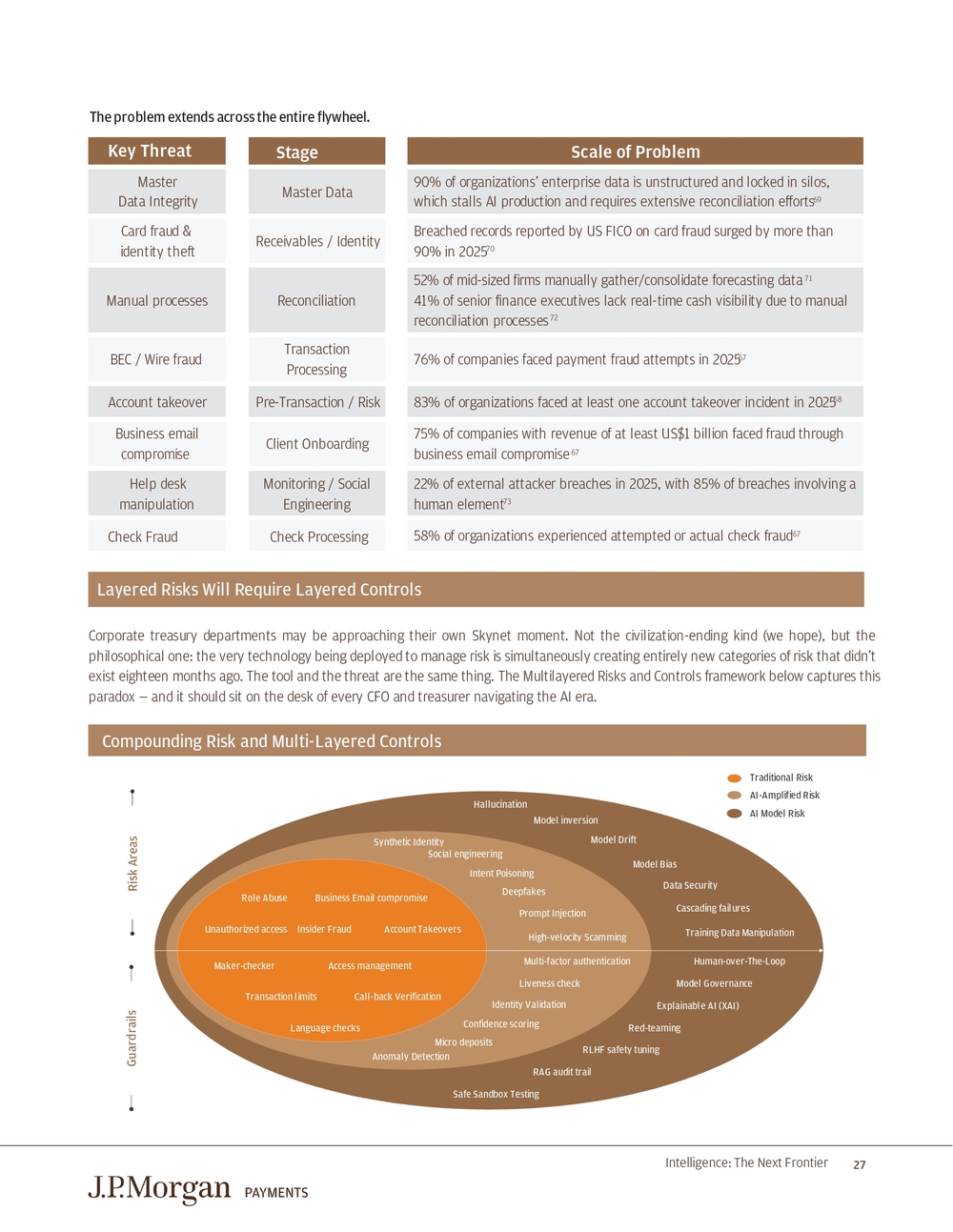
28 Intelligence: The Next Fr ontierLayer 1 — Traditional Risks represent the fraud and access threats treasury has battled for d ecad es: unauthorized access, insider fraud, ac count takeovers, BEC, and role abuse. The corresponding guardrails — maker-checke r , access management, transaction limits, call-back verification — are foundational. But with 76% of companies facing payment fraud attempts67 and account takeover fraud surging 354%, these controls alone are no longer sufficient74. Layer 2 — AI -Amplified Threats are where the paradox bites. Synthetic identity fraud, deep fakes, high-velocity scamming, social engineering at scale, and intent poisoning are not incremental evolutions — they are qu alitatively new attack vectors enabled by the same AI, treasury teams are adopting. The guardrails must match the sophistication: multi-factor authentication, liveness checks, identity validation, confidence scoring, anomaly detection, and micro-deposit verification. Most treasury departments are still building — not operating — this layer. Layer 3 — AI Model Risk is the most unsettling and least addressed. It represents risks created by AI systems themselves: hallucination, model drift, model bias, traini ng data manipulation, pr ompt injection, cascading failur es, and data security vulnerabilities. An AI cash forecasting model that silently drifts. A fraud detection model trained on biased data. A generative AI tool that hallucinates compliance lan guage. These demand fundamentally different controls: human-over-the-loop gove rnance, model governance frameworks, explainable AI, red-teaming, RLHF safety tuning, RAG audit trails, and safe sandbox testing. For treasury leaders, this means: (1) control frameworks must expand outward as technology adoption does; (2) the human-over-the- loop principle is non-negotiable for material treasury decisions — the speed advantag e of full automation is not worth the catastrophic downside of an unchecked hallucination in a payment workflow; and (3) treasury should look to have a seat at the enterprise AI governance table, because the risk tolerance for AI failure in payments is functionally zero. Compound volatility, regulatory density, and AI-amplified fraud are not separate challenges. They are interconnected. Geopolitical shocks create the chaos that fraudsters exploit. Regulatory responses to fraud and instability create new compliance obligations. And the same AI that powers fraud is also the most promising tool for detecting it — if deployed with the right governance and speed. The era of managing risks in silos is over. The Polycrisis demands Poly Intelligence. The treasuries that will thrive in this environment are those that build an intelligence function — not just risk management, not just compliance, but a connected capability that continuously monitors the geopolitical, regulatory, and threat landscape, translates signals into actionable foresight, and feeds that intelligence into operational decision-making in real time. The Intelligence Imperative: Connect the Three Dots
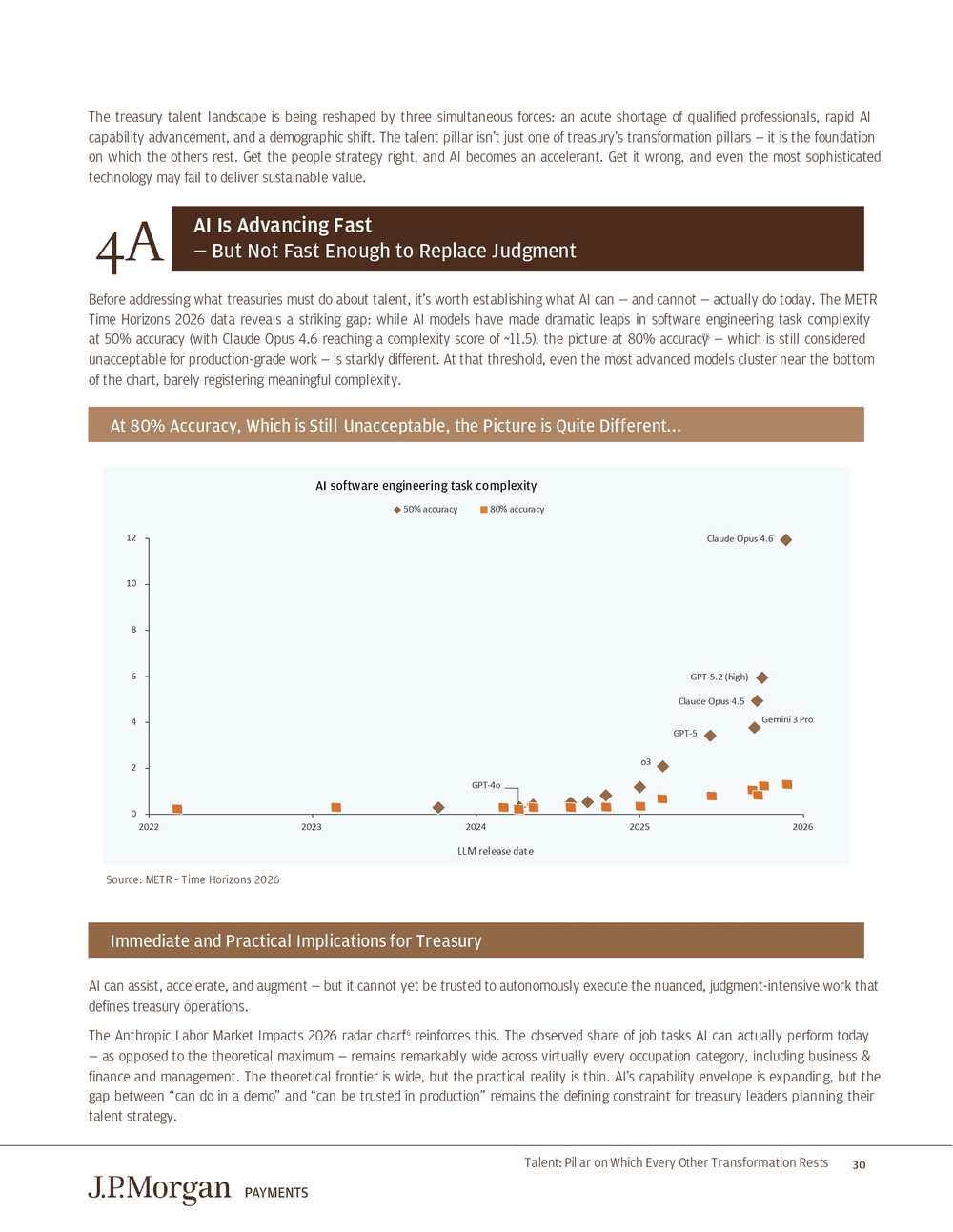
Talent: Pillar on Which Every
Other Transformation Rests04

30 Talent: Pillar on Which Ev ery Other Transformation RestsThe treasury talent landscape is being reshaped by three simultaneous forces: an acute shortage of qualified professionals, rapid AI capability advancement, and a demographic shift. The talent pillar isn’t just one of treasury’s transformation pillars — it is the foundation on which the others rest. Get the people strategy right, and AI becomes an accelerant. Get it wrong, and even the most sophisticated technology may fail to deliver sustainable value. Before addressing what treasuries must do about talent, it’s worth establishing what AI can — and cannot — actually do today. The METR Time Horizons 2026 data reveals a striking gap: while AI models have made dramatic leaps in software engineering task complexity at 50% accuracy (with Claude Opus 4.6 reaching a complexity score of ~11.5), the picture at 80% accuracy 75 — which is still considered unacceptable for production-grade work — is starkly different. At that threshold, even the most advanced models cluster near the bottom of the chart, barely registering meaningful complexity. AI can assist, accelerate, and augment — but it cannot yet be trusted to autonomously execute the nuanced, judgment-intensive work that defines treasury operations. The Anthropic Labor Market Impacts 2026 radar chart 76 reinforces this. The observed share of job tasks AI can actually perform today — as opposed to the theoretical maximum — remains remarkably wide across virtually every occupation category, including business & finance and management. The theoretical frontier is wide, but the practical reality is thin. AI’s capability envelope is expanding, but the gap between “can do in a demo” and “can be trusted in production” remains the defining constraint for treasury leaders planning their talent strategy.Immediate and Practical Implications for TreasuryAt 80% Accuracy, Which is Still Unacceptable, the Picture is Quite Different...4AAI Is Advancing Fast — But Not Fast Enough to Replace Judgment 024681012 2022 2023 2024 2025 202650% accuracy 80% accuracy GPT-4o Claude Opus 4.6 GPT-5.2 (high) Claude Opus 4.5 Gemini 3 Pro GPT-5 o3 LLM release dateAI software engineering task complexity Source: METR - Time Horizons 2026