2026_LATAM Agriculture landscape
by JPMorgan
S T R I C T L Y P R I V A T E A N D C O N F I D E N T I A L L ATA M A G R I C U LT U R E T R A D I N G L A N D S C A P E S T R I C T L Y P R I V A T E A N D C O N F I D E N T I A L
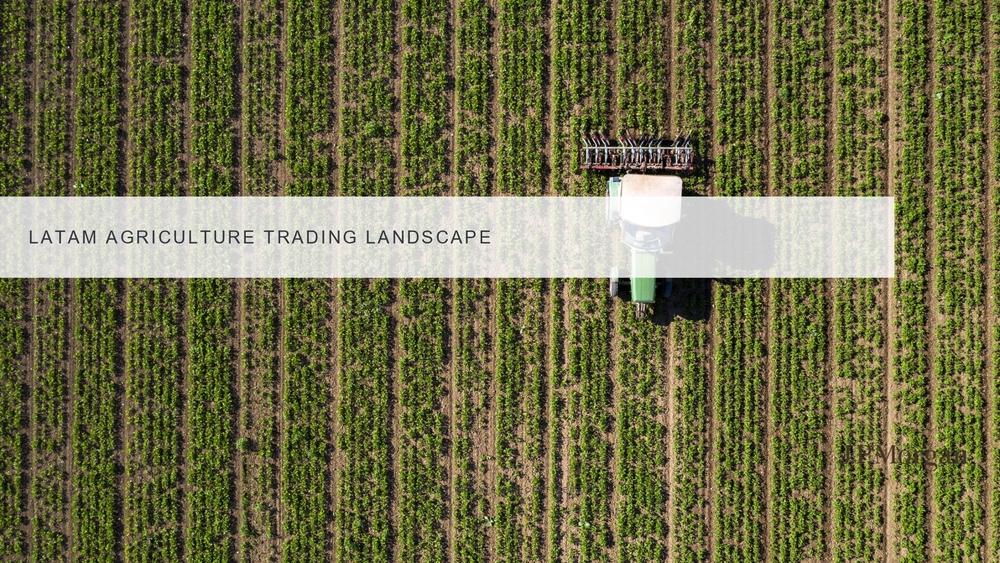
C O N F I D E N T I A L Navigating Change: Building Treasury Resilience in LATAM’s Agricultural Trading Sector “ “ Petra Gillis | Executive Director | Global Head of Advisory, Consumer, Retail, and Business Services – J.P. Morgan Payments In an increasingly interconnected and volatile agricultural trading environment, financial resilience is as important as operational strength. For Latin American traders, treasury plays a critical role in connecting liquidity, payments and risk management to support more resilient supply chains and long-term growth. LATAM is central to global food security, supplying a significant share of the world’s soybeans, coffee and sugar. Its agricultural trade is increasingly shaped by geopolitical tensions, shifting trade policies, climate disruptions and regulatory change. This publication explores how shifting demand, geopolitical volatility and changing commodity flows are reshaping LATAM agriculture and what this means for treasury. Brazil’s recent election and ongoing tax reform add policy uncertainty, while weather-driven production swings and changing sugar–ethanol economics shape commodity markets. Rising GLP-1 use may also alter food consumption and sugar demand over time. All of this, combined with an inherently fragmented, highly volatile environment, raises the stakes for corporate treasuries in the sector to ensure their companies deliver on their strategic and socio-economic purpose while managing risk in real time. Outlook for LATAM’s Agricultural Sector Source: USDA Foreign Agricultural Service (USDA FAS) – Coffee Production; 2026 Latin America Food & Agriculture Investment Report A resilient treasury in Latin America is essential because the region combines a critical role in global food security with an environment of high volatility How resilient is your treasury model to the next disruption in trade flows, commodity prices, or working capital? 1
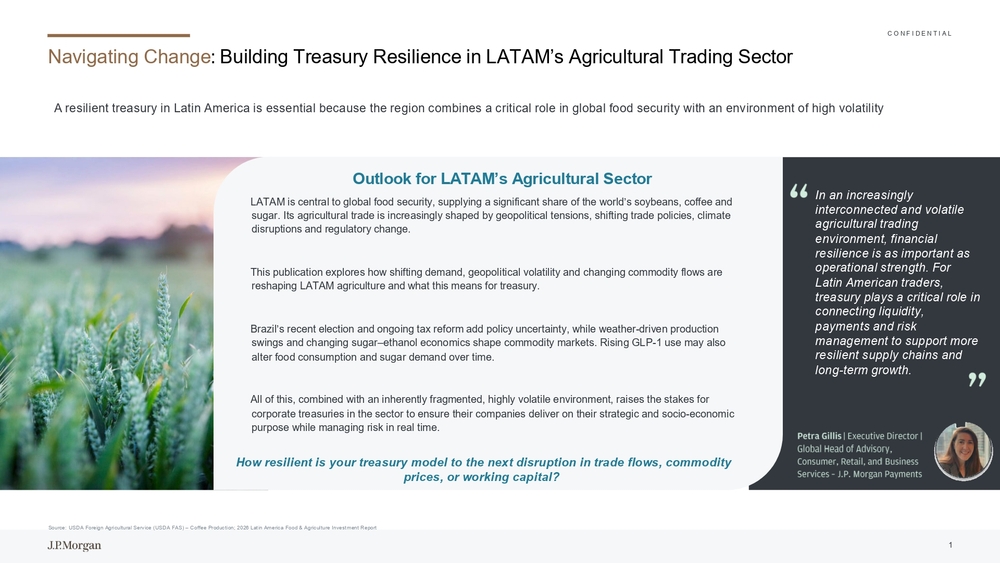
C O N F I D E N T I A L LATAM Agriculture Trading: Resilience, Reallocation & New Growth Geopolitics, biofuel demand and digitalization are reshaping trade flows - while margin pressure makes efficiency and resilience essential Source: 1 Rio Times 2 USDA FAS – Brazil: Biofuels Annual; 3 Reuters LATAM’s Agriculture Trading Sector Overview 1 2 3 4 5 6 Commodity-price volatility, elevated input costs and high financing costs are squeezing margins and increasing the focus on operational efficiency Asia’s growing food demand is strengthening LATAM trade corridors, with China accounting for ~79% 3 of Brazil’s soybean exports in 2025 AI and digital agriculture are improving yield forecasting and resource efficiency, offering significant potential to lower costs and agricultural emissions Policy mandates are accelerating LATAM’s biofuel opportunity, with Brazil raising ethanol blending to 32%, maintaining biodiesel at 15% 2 GLP-1 adoption could weigh on food-related sugar demand, while growing ethanol and biofuel use provides an alternative demand channel for sugarcane producers Tariffs, geopolitical tensions and political and regulatory shifts across LATAM are pushing exporters to diversify markets and strengthen supply-chain resilience Treasury Focus Areas Manage counterparty risk and FX exposure Rising funding needs and costs Cross-border payment complexity Limited cash visibility and cash forecasting needs Working capital pressure Optimize liquidity and intercompany funding 2
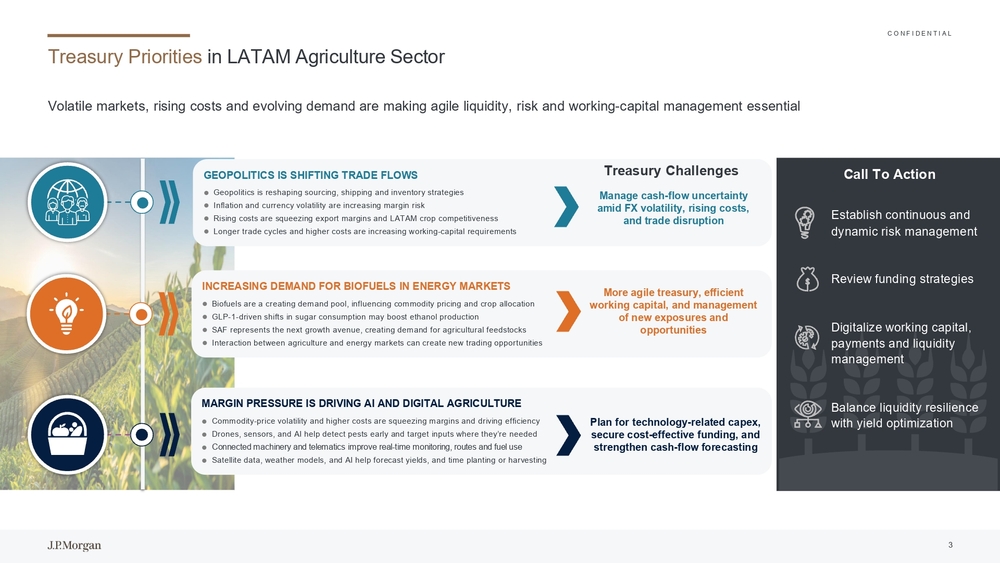
C O N F I D E N T I A L Treasury Priorities in LATAM Agriculture Sector GEOPOLITICS IS SHIFTING TRADE FLOWS ⚫ Geopolitics is reshaping sourcing, shipping and inventory strategies ⚫ Inflation and currency volatility are increasing margin risk ⚫ Rising costs are squeezing export margins and LATAM crop competitiveness ⚫ Longer trade cycles and higher costs are increasing working-capital requirements INCREASING DEMAND FOR BIOFUELS IN ENERGY MARKETS ⚫ Biofuels are a creating demand pool, influencing commodity pricing and crop allocation ⚫ GLP-1-driven shifts in sugar consumption may boost ethanol production ⚫ SAF represents the next growth avenue, creating demand for agricultural feedstocks ⚫ Interaction between agriculture and energy markets can create new trading opportunities MARGIN PRESSURE IS DRIVING AI AND DIGITAL AGRICULTURE ⚫ Commodity-price volatility and higher costs are squeezing margins and driving efficiency ⚫ Drones, sensors, and AI help detect pests early and target inputs where they’re needed ⚫ Connected machinery and telematics improve real-time monitoring, routes and fuel use ⚫ Satellite data, weather models, and AI help forecast yields, and time planting or harvesting Treasury Challenges Manage cash-flow uncertainty amid FX volatility, rising costs, and trade disruption Plan for technology-related capex, secure cost-effective funding, and strengthen cash-flow forecasting More agile treasury, efficient working capital, and management of new exposures and opportunities Call To Action Establish continuous and dynamic risk management Review funding strategies Digitalize working capital, payments and liquidity management Balance liquidity resilience with yield optimization Volatile markets, rising costs and evolving demand are making agile liquidity, risk and working-capital management essential 3
C O N F I D E N T I A L Disclaimer This material was prepared exclusively for the benefit and internal use of the JPMorgan client to whom it is directly addressed (including such client’s subsidiaries, the “Company”) in order to assist the Company in evaluating a possible transaction(s) and does not carry any right of disclosure to any other party. In preparing this material, we have relied upon and assumed, without independent verification, the accuracy and completeness of all information available from public sources or which was provided to us by or on behalf of the Company or which was otherwise reviewed by us. This material is for discussion purposes only and is incomplete without reference to the other briefings provided by JPMorgan. Neither this material nor any of its contents may be disclosed or used for any other purpose without the prior written consent of JPMorgan. This material is not intended to provide legal, tax, investment, accounting, financial, business, real estate, technology or other advice, and should not be used for or relied upon for these purposes. The views, opinions, estimates and strategies expressed in this material are those of the respective individual contributors, authors or speakers, and may differ from those of JPMorganChase, or its employees and affiliates. Any market and/or economic commentary in this material in no way constitutes JPMorganChase research and should not be treated as such. Further, the views expressed in this content may differ from those contained in JPMorganChase research reports. The content in this material has been obtained from sources deemed to be reliable, but JPMorganChase makes no representation or warranty as to its accuracy or completeness. In no event shall JPMorganChase nor any of its directors, officers, employees or agents be liable for any use of, for any decision made or action taken in reliance upon, or for any inaccuracies or errors in or omissions from, this material. J.P. Morgan, JPMorgan, JPMorgan Chase, Chase, Chase Merchant Services, and Chase Payment Solutions are marketing names for certain businesses of JPMorgan Chase & Co. and its subsidiaries worldwide (collectively, “JPMC”). Products or services may be marketed and/or provided by commercial banks such as JPMorgan Chase Bank, N.A., securities or other non-banking affiliates or other JPMC entities. JPMC contact persons may be employees or officers of any of the foregoing entities and the terms “J.P. Morgan”, “JPMorgan”, “JPMorgan Chase”, “Chase”, “Chase Merchant Services” and “Chase Payment Solutions” if and as used herein include as applicable all such employees or officers and/or entities irrespective of marketing name(s) used. Nothing in this material is a solicitation by JPMC of any product or service which would be unlawful under applicable laws or regulations. Investments or strategies discussed herein may not be suitable for all investors. Neither JPMorgan nor any of its directors, officers, employees or agents shall incur in any responsibility or liability whatsoever to the Company or any other party with respect to the contents of any matters referred herein, or discussed as a result of, this material. This material is not intended to provide, and should not be relied on for, accounting, legal or tax advice or investment recommendations. Please consult your own tax, legal, accounting or investment advisor concerning such matters. Not all products and services are available in all geographic areas. Eligibility for particular products and services is subject to final determination by JPMC and or its affiliates. This material does not constitute a commitment by any JPMC entity to extend or arrange credit or to provide any other products or services and JPMorgan reserves the right to withdraw at any time. All products and services are subject to applicable laws, regulations, and applicable approvals and notifications. The Company should examine the specific restrictions and limitations under the laws of its own jurisdiction that may be applicable to the Company due to its nature or to the products and services referred herein. Any mentions of third-party trademarks, brand names, products and services are for referential purposes only and any mention thereof is not meant to imply any sponsorship, endorsement, or affiliation. Notwithstanding anything to the contrary, the statements in this material are not intended to be legally binding. Any products, services, terms or other matters described herein (other than in respect of confidentiality) are subject to, and superseded by, the terms of separate legally binding documentation and/or are subject to change without notice. Changes to Interbank Offered Rates (IBORs) and other benchmark rates: Certain interest rate benchmarks are, or may in the future become, subject to ongoing international, national and other regulatory guidance, reform and proposals for reform. For more information, please consult: https://www.jpmorgan.com/global/disclosures/interbank_offered_rates. JPMorgan Chase Bank, N.A. Member FDIC. Deposits held in non-U.S. branches are not FDIC insured. Non-deposit products are not FDIC insured. JPMorgan Chase Bank, N.A., organized under the laws of U.S.A. with limited liability. © 2026 JPMorgan Chase & Co. All Rights Reserved. 4